Chemical changes are ubiquitous in our world. From the digestion of food to the combustion of fossil fuels, these reactions play a vital role in countless natural and industrial processes. But what exactly happens during a chemical change, and how can we differentiate it from a physical change?

Definition of Chemical Change
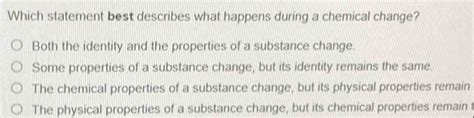
A chemical change, also known as a chemical reaction, occurs when the atoms or molecules of a substance rearrange to form new substances. This process involves the breaking and forming of chemical bonds, resulting in the creation of new molecules with distinct properties.
Key Features of Chemical Changes
Several characteristics distinguish chemical changes from physical changes:
- Formation of new substances: Chemical reactions produce new compounds with unique chemical properties and structures.
- Energy change: Chemical changes usually involve the release or absorption of energy, often in the form of heat, light, or sound.
- Creation of new bonds: Chemical reactions involve the breaking and forming of chemical bonds between atoms or molecules.
- Irreversibility: Many chemical changes are irreversible, meaning that the original substances cannot be easily recovered once the reaction has occurred.
Types of Chemical Changes
Chemical changes can be categorized into various types based on their characteristics:
- Combination reactions: Two or more substances combine to form a single new substance.
- Decomposition reactions: A single substance breaks down into two or more new substances.
- Single-replacement reactions: One element replaces another in a compound.
- Double-replacement reactions: Two compounds exchange ions to form two new compounds.
- Combustion reactions: A substance reacts with oxygen, usually producing carbon dioxide and water.
Practical Applications of Chemical Changes
Chemical changes find widespread applications in various fields:
- Medicine: Drug synthesis, disease diagnosis, and medical imaging
- Industry: Manufacturing of plastics, fertilizers, and fuels
- Energy: Generation of electricity, production of biofuels
- Agriculture: Crop improvement, pest control, fertilizer production
- Environmental science: Pollution control, waste treatment
Common Mistakes to Avoid
When studying chemical changes, it is important to avoid certain common mistakes:
- Confusing chemical changes with physical changes
- Assuming that all chemical changes are irreversible
- Neglecting the role of energy in chemical reactions
- Ignoring the importance of balanced chemical equations
Benefits and Drawbacks of Chemical Changes
Chemical changes offer several benefits:
- Creation of new materials with desired properties
- Production of energy sources
- Enhancement of agricultural productivity
- Improvement of medical treatments
However, there are also potential drawbacks:
- Release of harmful byproducts
- Consumption of non-renewable resources
- Environmental pollution
- Safety hazards associated with chemical reactions
Frequently Asked Questions (FAQs)
-
What is the difference between a chemical change and a physical change?
– Chemical changes involve the formation of new substances, while physical changes only alter the physical form of a substance. -
How do I know if a chemical change has occurred?
– Observe changes in color, odor, temperature, the formation of bubbles, or the production of light. -
Are all chemical changes exothermic?
– No, some chemical changes release energy (exothermic), while others absorb energy (endothermic). -
Can chemical changes be reversed?
– Some chemical changes can be reversed, while others are irreversible. -
What are the safety precautions to consider when working with chemical reactions?
– Wear protective gear, work in a well-ventilated area, and follow proper disposal procedures. -
How do chemical changes contribute to our daily lives?
– Chemical changes play a crucial role in food preservation, the production of medicines, the generation of electricity, and countless other everyday applications.
Conclusion
Chemical changes are fundamental processes that involve the rearrangement of atoms or molecules to form new substances. Understanding the characteristics, types, and applications of chemical changes empowers us to harness their benefits while mitigating potential risks. By paying attention to safety precautions and fostering a deeper understanding of these reactions, we can harness the transformative power of chemistry for the betterment of society and the environment.