Charles Darwin’s theory of evolution by natural selection was the culmination of many years of observation and research. His groundbreaking work, published in 1859 in the book “On the Origin of Species,” revolutionized our understanding of the natural world and its inhabitants.

Darwin’s Journey and Observations
Darwin’s most famous voyage was aboard the HMS Beagle, a British naval ship that sailed around the world from 1831 to 1836. During this expedition, Darwin made extensive observations of the plant and animal life he encountered, paying particular attention to the similarities and differences between species in different geographical regions.
Key Observations that Shaped Darwin’s Theory
Several key observations made by Darwin during his voyage and subsequent research laid the foundation for his major inferences:
1. Variation within Species
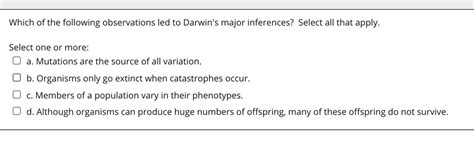
Darwin noted that individuals within the same species exhibit a wide range of traits, such as size, color, and behavior. This variation is essential for the process of natural selection to operate.
2. Inheritance of Traits
Darwin observed that many traits were passed from parents to offspring, a phenomenon now known as heredity. This suggests that the variations seen within a species could be inherited, forming the basis for the evolution of new traits.
3. Overproduction of Offspring
Darwin recognized that organisms tend to produce more offspring than can survive and reach reproductive maturity. This overproduction creates competition for limited resources, such as food, water, and shelter.
4. Survival of the Fittest
Darwin observed that in the face of competition, the individuals with traits that make them best suited to their environment are more likely to survive and reproduce. This process, known as natural selection, favors the survival and perpetuation of advantageous traits in a population.
Darwin’s Major Inferences
Based on these observations, Darwin made his major inferences about evolution:
1. Common Ancestry
Darwin inferred that all living organisms share a common ancestor, from which they have evolved over time. This shared ancestry explains the similarities observed among different species.
2. Gradualism
Darwin proposed that evolution occurs gradually over long periods, with small, incremental changes in populations over many generations. This gradual process allows for the accumulation of significant changes over time.
3. Natural Selection
Darwin emphasized natural selection as the primary mechanism driving evolution. Natural selection operates when individuals with advantageous traits have a better chance of surviving and reproducing, passing on their beneficial traits to their offspring.
Impact of Darwin’s Theory
Darwin’s theory of evolution had a profound impact on the scientific community and beyond, challenging long-held beliefs about the origin and diversity of life. It provided a scientific explanation for the adaptation and diversity of species, ultimately shaping our understanding of our place in the natural world.