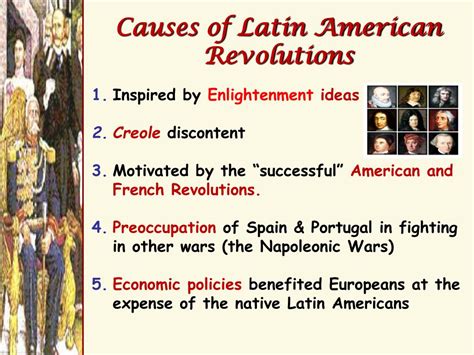
The Latin American Revolution was a period of political and social upheaval that took place in the early 19th century, leading to the independence of most of the Spanish and Portuguese colonies in the Americas. The causes of the revolution were complex and varied, but they can be broadly classified into three main categories:

Political Causes
- Colonial rule: The Spanish and Portuguese empires were largely exploitative, with the colonies being treated as sources of raw materials and revenue. This led to widespread resentment among the Creole population, who were born in the colonies but of European descent.
- Enlightenment ideas: The 18th century Enlightenment in Europe spread new ideas about liberty, equality, and self-determination. These ideas inspired many Creole intellectuals to question the legitimacy of colonial rule.
- French Revolution: The success of the French Revolution in 1789 showed that it was possible to overthrow an oppressive government and establish a new, more democratic society. This inspired many Latin American revolutionaries to believe that they could do the same.
Economic Causes
- Economic inequality: The Creole population was largely excluded from the most lucrative economic opportunities, which were reserved for those born in Spain or Portugal. This led to widespread economic resentment and a desire for greater economic autonomy.
- Mercantilism: The mercantilist policies of the Spanish and Portuguese empires restricted the economic development of the colonies. This led to frustration among the Creole population, who wanted to be able to trade more freely with other countries.
- Agricultural crisis: The late 18th century saw a series of agricultural crises in Latin America, which led to widespread famine and poverty. This further increased resentment against colonial rule.
Social Causes
- Racial discrimination: The Spanish and Portuguese empires practiced racial discrimination against the indigenous population of the Americas. This led to widespread resentment and a desire for equality.
- Caste system: The Spanish and Portuguese empires also imposed a rigid caste system on the colonies, which divided society into different social classes. This led to widespread resentment among the lower classes, who wanted to be able to improve their social status.
- Cultural differences: The Spanish and Portuguese empires tried to impose their own cultures on the colonies, which led to widespread resentment among the Creole population, who wanted to preserve their own cultural traditions.
The Latin American Revolution was a complex and multifaceted event that was caused by a variety of political, economic, and social factors. These factors combined to create a situation in which the Creole population was no longer willing to tolerate colonial rule. The revolution was a success, and it led to the independence of most of the Spanish and Portuguese colonies in the Americas.
Key Figures in the Latin American Revolution
Some of the key figures in the Latin American Revolution include:
- Simón Bolívar: Bolívar was a Venezuelan military leader who is considered one of the most important figures in the Latin American Revolution. He led a series of successful military campaigns that led to the independence of Venezuela, Colombia, Ecuador, and Peru.
- José de San Martín: San Martín was an Argentine military leader who played a key role in the independence of Argentina, Chile, and Peru. He led a daring campaign across the Andes Mountains to liberate Chile from Spanish rule.
- Miguel Hidalgo: Hidalgo was a Mexican priest who led a mass uprising against Spanish rule in 1810. Although his rebellion was eventually defeated, it inspired other Mexican revolutionaries to continue the fight for independence.
- José María Morelos: Morelos was a Mexican priest and military leader who led a successful rebellion against Spanish rule in southern Mexico. He was eventually captured and executed by the Spanish, but his legacy lived on.
Timeline of the Latin American Revolution
The Latin American Revolution took place over a period of several decades, from the late 18th century to the early 19th century. Here is a timeline of some of the key events:
- 1789: The French Revolution begins.
- 1808: The Spanish king, Ferdinand VII, is deposed by Napoleon Bonaparte.
- 1810: Miguel Hidalgo leads a mass uprising against Spanish rule in Mexico.
- 1811: José María Morelos leads a successful rebellion against Spanish rule in southern Mexico.
- 1816: Simón Bolívar begins his campaign to liberate Venezuela from Spanish rule.
- 1817: José de San Martín begins his campaign to liberate Argentina, Chile, and Peru from Spanish rule.
- 1821: Mexico gains independence from Spain.
- 1822: Peru gains independence from Spain.
- 1823: Brazil gains independence from Portugal.
- 1825: Bolivia gains independence from Spain.
Impact of the Latin American Revolution
The Latin American Revolution had a profound impact on the Americas. It led to the independence of most of the Spanish and Portuguese colonies in the Americas, and it helped to spread the ideals of liberty, equality, and self-determination throughout the region. The revolution also had a major impact on the development of the United States, as it helped to inspire the American Revolution.
Here are some of the specific impacts of the Latin American Revolution:
- Political: The Latin American Revolution led to the establishment of new, independent republics in the Americas. These new republics were based on the principles of liberty, equality, and self-determination.
- Economic: The Latin American Revolution led to the opening up of the Americas to free trade. This led to a period of economic growth and prosperity in the region.
- Social: The Latin American Revolution led to the abolition of slavery in many parts of the Americas. It also led to the improvement of the social status of indigenous peoples and other marginalized groups.
- Cultural: The Latin American Revolution led to the flowering of new, independent cultures in the Americas. These new cultures were a blend of European, indigenous, and African influences.
The Latin American Revolution was a watershed event in the history of the Americas. It led to the independence of most of the Spanish and Portuguese colonies in the region, and it helped to spread the ideals of liberty, equality, and self-determination throughout the world.