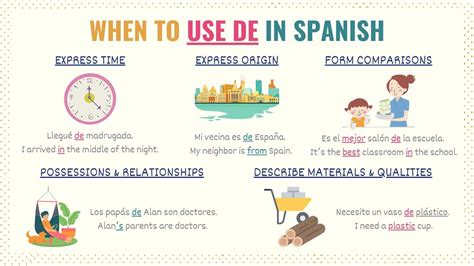
When you’re learning Spanish, you’ll quickly come across the phrase “es de.” This phrase is used to indicate that something belongs to someone or something else. For example, you might say “El libro es de María” to say “The book belongs to Maria.”
“Es de” can also be used to indicate that something is made of a particular material. For example, you might say “La mesa es de madera” to say “The table is made of wood.”
In addition to these basic uses, “es de” can also be used in a variety of other ways. For example, it can be used to indicate that something is from a particular place or that it has a particular quality.
Here are some additional examples of how “es de” can be used:
- Es de España. (He is from Spain.)
- Es de buena calidad. (It is of good quality.)
- Es de color rojo. (It is red.)
- Es de mi padre. (It is my father’s.)
Conjugation of “Es De”
The verb “ser” is used to conjugate “es de.” The conjugation of “ser” depends on the person and number of the subject.
Here is a table showing the conjugation of “es de” in the present tense:
| Person | Number | Conjugation |
|---|---|---|
| Yo | Singular | Soy de |
| Tú | Singular | Eres de |
| Él/Ella/Usted | Singular | Es de |
| Nosotros/Nosotras | Plural | Somos de |
| Vosotros/Vosotras | Plural | Sois de |
| Ellos/Ellas/Ustedes | Plural | Son de |
Examples
Here are some examples of how “es de” can be used in sentences:
- Soy de México. (I am from Mexico.)
- Eres de España. (You are from Spain.)
- La casa es de mi abuela. (The house is my grandmother’s.)
- El libro es de la biblioteca. (The book is from the library.)
- El coche es de color rojo. (The car is red.)
Exercises
Translate the following sentences into Spanish:
- I am from the United States.
- You are from England.
- The book is from the library.
- The car is blue.
- The house is my father’s.
Answers
- Soy de los Estados Unidos.
- Eres de Inglaterra.
- El libro es de la biblioteca.
- El coche es azul.
- La casa es de mi padre.