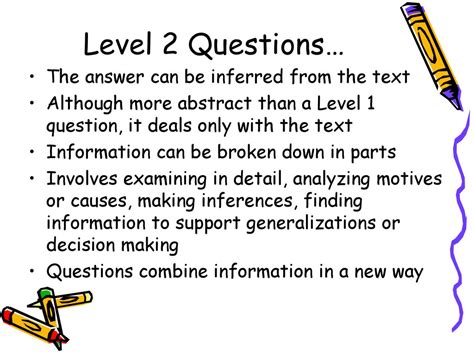
A level 2 question is a question that requires the reader to think critically and apply their knowledge to a new situation. It is a more complex question than a level 1 question, and it requires the reader to draw conclusions and make inferences.

Characteristics of Level 2 Questions:
- Require critical thinking and application of knowledge
- Demand analysis, synthesis, and evaluation
- Often involve multiple steps or layers of reasoning
- Seek to assess higher-order cognitive skills
To answer a level 2 question effectively, follow these steps:
- Read the question carefully: Identify the key concepts and information in the question.
- Analyze the question: Determine the type of question (e.g., compare, contrast, analyze) and the expected response.
- Gather evidence: Identify relevant information from the text or your prior knowledge.
- Formulate a response: Draw conclusions, make inferences, and support your answer with evidence.
- Evaluate your response: Ensure your answer is logical, well-reasoned, and addresses the question fully.
Example 1:
Analyze the similarities and differences between the American Revolution and the French Revolution. How did each revolution contribute to the development of democratic principles?
Example 2:
Evaluate the economic and social impact of globalization. Discuss its benefits and challenges, providing specific examples.
Example 3:
Consider the ethical implications of artificial intelligence. What safeguards can be implemented to minimize potential biases and promote fairness?
Table 1: Bloom’s Taxonomy
| Level | Cognitive Process |
|---|---|
| 1 | Knowledge |
| 2 | Comprehension |
| 3 | Application |
| 4 | Analysis |
| 5 | Synthesis |
| 6 | Evaluation |
Table 2: Cognitive Skills Assessed by Level 2 Questions
| Skill | Description |
|---|---|
| Critical thinking | Analyzing, evaluating, and synthesizing information |
| Application | Using knowledge in new situations |
| Inference | Drawing conclusions from given information |
| Generalization | Identifying patterns and making predictions |
Table 3: Strategies for Answering Level 2 Questions
| Strategy | Description |
|---|---|
| Use evidence | Support your answer with specific examples or research |
| Organize your thoughts | Structure your answer logically with an introduction, body, and conclusion |
| Be precise | Use clear and concise language |
| Use appropriate vocabulary | Use terms and concepts relevant to the question |
Table 4: Tips and Tricks
| Tip | Description |
|---|---|
| Practice regularly | The more you practice, the better you will become at answering level 2 questions |
| Break down the question | Divide the question into smaller parts to make it easier to understand |
| Brainstorm ideas | Generate multiple ideas before selecting the best answer |
| Seek feedback | Ask a teacher or peer to review your answer and provide feedback |
1. What is the difference between a level 1 and a level 2 question?
A level 1 question requires basic knowledge and comprehension, while a level 2 question requires critical thinking and application of knowledge.
2. How can I prepare for answering level 2 questions?
Practice regularly, break down questions, and brainstorm ideas.
3. What are some examples of level 2 questions?
See the examples provided in the article.
4. Why are level 2 questions important?
They assess higher-order cognitive skills and prepare students for real-world challenges.
5. How can I use level 2 questions in the classroom?
Incorporate them into discussions, assignments, and assessments to promote critical thinking and application of knowledge.
6. How can I develop creative new applications for level 2 questions?
Use “knowstorming” techniques to generate ideas and explore different scenarios and contexts.