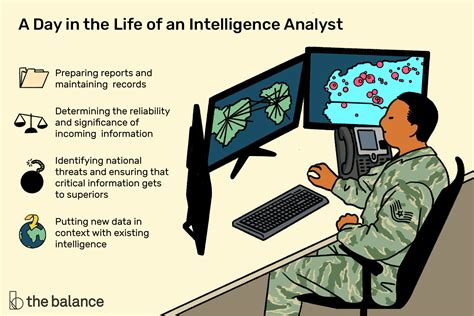
Intelligence analysts are professionals who collect, analyze, and interpret information to provide insights and recommendations to decision-makers. They play a critical role in national security, law enforcement, business, and other fields.

Key Responsibilities
Intelligence analysts perform a wide range of tasks, including:
- Collecting information: Gathering data from various sources, such as human intelligence (HUMINT), signals intelligence (SIGINT), and open-source intelligence (OSINT).
- Analyzing information: Examining data to identify patterns, trends, and anomalies.
- Interpreting information: Drawing conclusions and formulating insights based on the analysis.
- Producing intelligence reports: Summarizing findings, providing recommendations, and briefing decision-makers.
- Monitoring developments: Staying abreast of current events and ongoing threats to inform decision-making.
Core Skills
Intelligence analysts require a diverse set of skills, including:
- Analytical skills: Strong critical thinking, problem-solving, and data analysis abilities.
- Research skills: Proficiency in gathering and evaluating information from multiple sources.
- Communication skills: Ability to convey complex information clearly and effectively.
- Foreign language proficiency: Knowledge of one or more foreign languages to facilitate information gathering and analysis.
- Technical skills: Familiarity with intelligence analysis software and tools.
Applications of Intelligence Analysis
Intelligence analysis has numerous applications across various fields, including:
- National security: Providing insights into foreign affairs, military operations, and terrorism threats.
- Law enforcement: Investigating crimes, identifying suspects, and developing strategies to combat organized crime.
- Business intelligence: Analyzing market trends, competitor activity, and customer behavior to inform business decisions.
- Financial intelligence: Detecting financial crimes, such as money laundering and terrorist financing.
- Cybersecurity: Monitoring cyber threats, identifying vulnerabilities, and developing mitigation strategies.
Workforce and Industry Trends
- The global intelligence market is projected to reach $27.3 billion by 2027, growing at a compound annual growth rate (CAGR) of 6.2%.
- There is a high demand for intelligence analysts with specialized skills, such as cybersecurity, financial analysis, and data science.
- Artificial intelligence (AI) is increasingly being used to automate tasks and improve the efficiency of intelligence analysis.
Tips and Tricks for Aspiring Analysts
- Develop analytical skills: Take courses in statistics, data analysis, and critical thinking.
- Gain experience in information gathering and analysis: Volunteer for internships or research projects.
- Stay informed: Read news and professional journals to stay abreast of current events and industry trends.
- Network with professionals: Attend industry events and connect with analysts on LinkedIn.
- Consider advanced education: Master’s degrees in intelligence analysis or related fields can enhance career prospects.
Step-by-Step Approach to Intelligence Analysis
- Define the problem: Identify the intelligence question or problem that needs to be addressed.
- Collect information: Gather data from various sources to inform the analysis.
- Analyze information: Examine data to identify patterns, trends, and anomalies.
- Interpret information: Draw conclusions and formulate insights based on the analysis.
- Produce intelligence report: Summarize findings, provide recommendations, and brief decision-makers.
Case Studies
Case Study 1: Detecting Terrorist Threats
Intelligence analysts use a combination of HUMINT, SIGINT, and OSINT to identify potential terrorist threats. They analyze communication patterns, travel history, and other data to identify individuals and groups who may be planning attacks. The timely detection of terrorist activities has prevented numerous planned attacks, saving countless lives.
Case Study 2: Combating Organized Crime
Intelligence analysts collaborate with law enforcement agencies to investigate organized crime networks. They analyze financial transactions, phone records, and other data to identify key players, funding sources, and distribution routes. This information has led to the dismantling of major criminal organizations and the seizure of illicit drugs and assets.
Frequently Asked Questions (FAQs)
What is the difference between intelligence analysts and espionage agents?
Intelligence analysts collect and analyze information from various sources, while espionage agents gather confidential information through covert operations.
What are the career prospects for intelligence analysts?
Intelligence analysts can advance to senior positions, such as analysts, managers, and directors. They may also specialize in specific fields, such as terrorism, cyber intelligence, or financial analysis.
How can I become an intelligence analyst?
Most intelligence analysts have a bachelor’s degree in intelligence studies, international relations, or a related field. They often undergo specialized training and certification programs.
What are the ethical considerations for intelligence analysts?
Intelligence analysts must adhere to ethical guidelines to ensure that information is collected and used responsibly. They must balance the need for national security with the privacy and civil liberties of individuals.