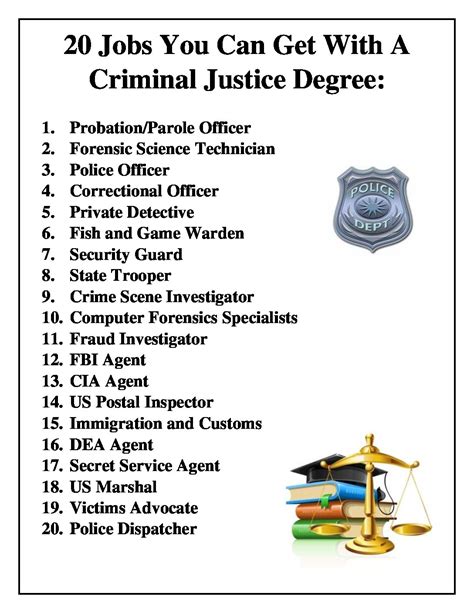
Earning a criminal justice degree provides a solid foundation for a wide range of careers in law enforcement, corrections, and the justice system. With a comprehensive understanding of criminal law, criminological theory, and investigative techniques, graduates are well-equipped to pursue diverse roles that contribute to public safety and the administration of justice.

Law Enforcement
- Police Officer: Enforce laws, investigate crimes, and maintain public order. According to the Bureau of Labor Statistics (BLS), the median annual salary for police officers is $67,290 (2021).
- Detective: Investigate major crimes, collect evidence, and identify suspects. The BLS reports a median annual salary of $96,080 for detectives (2021).
- Sheriff’s Deputy: Provide law enforcement services in rural areas and counties. The BLS estimates that sheriff’s deputies earn a median annual salary of $64,330 (2021).
- Federal Agent: Investigate and enforce federal laws, such as drug trafficking, cybercrime, and national security threats. The salaries for federal agents vary widely depending on the agency and job title.
Corrections
- Correctional Officer: Supervise inmates in prisons, jails, and other correctional facilities. The BLS reports a median annual salary of $51,500 for correctional officers (2021).
- Probation Officer: Monitor and supervise individuals who have been convicted of crimes but are serving their sentences outside of jail or prison. The median annual salary for probation officers is $59,510 (BLS, 2021).
- Parole Officer: Supervise and guide individuals who have been released from prison. The BLS estimates a median annual salary of $60,760 for parole officers (2021).
- Crime Scene Technician: Collect and analyze evidence from crime scenes. The median annual salary for crime scene technicians is $64,520 (BLS, 2021).
Justice System
- Court Administrator: Manage the operations and administrative functions of courts. The median annual salary for court administrators is $95,580 (BLS, 2021).
- Victim Advocate: Provide support and assistance to victims of crime. The median annual salary for victim advocates is $50,550 (BLS, 2021).
- Forensic Scientist: Analyze and interpret physical evidence in criminal investigations. The BLS reports a median annual salary of $63,670 for forensic scientists (2021).
- Criminal Justice Researcher: Conduct research on crime, criminal behavior, and the justice system. The median annual salary for criminal justice researchers is $83,660 (BLS, 2021).
Other Related Careers
- Private Investigator: Conduct investigations for individuals, businesses, and attorneys.
- Loss Prevention Specialist: Prevent and investigate retail theft and fraud.
- Security Specialist: Design and implement security measures for businesses and organizations.
- Intelligence Analyst: Collect and analyze intelligence on criminal activities and threats.
Income and Employment Outlook
The job outlook for criminal justice professionals is expected to grow faster than average in coming years. The BLS projects a 7% increase in employment for police officers and detectives from 2021 to 2031, and a 6% increase for correctional officers and probation officers.
Table 1: Median Annual Salaries for Criminal Justice Careers
| Career | Median Annual Salary |
|---|---|
| Police Officer | $67,290 |
| Detective | $96,080 |
| Sheriff’s Deputy | $64,330 |
| Correctional Officer | $51,500 |
| Probation Officer | $59,510 |
| Parole Officer | $60,760 |
| Crime Scene Technician | $64,520 |
| Court Administrator | $95,580 |
| Victim Advocate | $50,550 |
| Forensic Scientist | $63,670 |
| Criminal Justice Researcher | $83,660 |
Table 2: Projected Employment Growth for Criminal Justice Occupations
| Occupation | Employment Growth 2021-2031 |
|---|---|
| Police Officers and Detectives | 7% |
| Correctional Officers | 6% |
| Probation Officers | 6% |
Choosing a Career Path
Selecting a specific career path within criminal justice requires careful consideration of interests, skills, and personality traits. Here are some factors to consider:
- Interest in law enforcement or corrections: Do you prefer working directly with suspects and criminals, or do you prefer a role that focuses more on rehabilitation and community support?
- Strong ethics and values: The justice system demands unwavering integrity and ethical decision-making.
- Empathy and compassion: Helping victims and offenders requires a deep understanding of human behavior and the ability to relate to others.
- Communication and interpersonal skills: Strong communication and interpersonal skills are essential for effectively interacting with the public, colleagues, and individuals in the justice system.
- Ability to work under pressure and manage stress: Criminal justice professionals often face demanding and stressful situations.
Table 3: Criminal Justice Specializations
| Specialization | Degree Offered |
|---|---|
| Crime Scene Investigation | Bachelor’s, Master’s |
| Criminology | Bachelor’s, Master’s, Ph.D. |
| Cybercrime | Bachelor’s, Master’s |
| Forensic Science | Bachelor’s, Master’s, Ph.D. |
| Homeland Security | Bachelor’s, Master’s |
| Juvenile Justice | Bachelor’s, Master’s |
| Law Enforcement Administration | Bachelor’s, Master’s |
| Legal Studies | Bachelor’s |
| Victim Services | Bachelor’s, Master’s |
Table 4: Types of Criminal Justice Degrees
| Degree Level | Focus |
|---|---|
| Associate’s Degree | General overview of criminal justice |
| Bachelor’s Degree | Comprehensive education in criminal justice theory and practice |
| Master’s Degree | Advanced knowledge and specialization in specific areas of criminal justice |
| Ph.D. | Research and teaching in criminal justice |
Advancement Opportunities
With experience and additional training, criminal justice professionals can advance to higher-level positions within law enforcement, corrections, or the justice system. Some common career paths include:
- Sergeant
- Lieutenant
- Captain
- Chief of Police
- Warden
- Administrator
- Judge
- Professor
Conclusion
A criminal justice degree provides a valuable foundation for a diverse range of careers in the justice system. Whether you aspire to protect public safety, rehabilitate offenders, or contribute to the administration of justice, there are numerous pathways available to harness your passion for justice and make a meaningful difference in society.