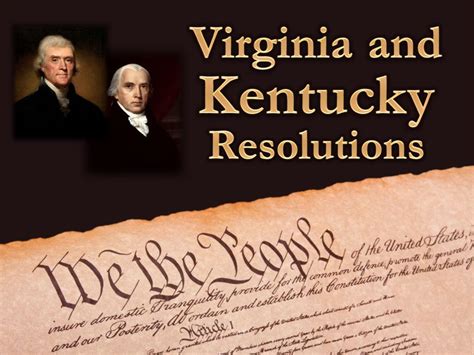
The Genesis of the Resolutions
The Virginia and Kentucky Resolutions were seminal documents that challenged the federal government’s powers under the Constitution. Drafted in response to the Alien and Sedition Acts of 1798, these resolutions articulated the states’ rights theory of federalism, which emphasized the sovereignty of individual states.

The Alien and Sedition Acts were a series of laws passed by the Federalist-controlled Congress that gave the president the power to deport aliens considered dangerous and to punish those who criticized the government. These acts were widely seen as an infringement on individual liberties and states’ rights.
The Virginia Resolutions
In 1798, the Virginia General Assembly adopted a set of resolutions written by James Madison. These resolutions asserted that the states had the right to nullify federal laws that they deemed unconstitutional. Madison argued that the Constitution was a compact between the states and that each state had the final say over its own sovereignty.
The Kentucky Resolutions
In 1799, the Kentucky General Assembly adopted a set of resolutions authored by Thomas Jefferson. Similar to the Virginia Resolutions, the Kentucky Resolutions asserted the principle of nullification but went further by suggesting that the states could secede from the Union if the federal government continued to infringe on their rights.
The Impact of the Resolutions
The Virginia and Kentucky Resolutions sparked a heated debate over the nature of federalism in the United States. Federalists, led by Alexander Hamilton, argued that the federal government had the supreme authority over the states. Republicans, led by Thomas Jefferson and James Madison, maintained that the states retained the ultimate power to determine the constitutionality of federal laws.
The debate over the resolutions influenced the development of American constitutional law and political thought. Ultimately, the principle of nullification was never fully embraced by the Supreme Court or the federal government. However, the resolutions remain a testament to the struggle between the federal government and the states over the limits of federal power.
The Significance of the Resolutions
The Virginia and Kentucky Resolutions are significant for the following reasons:
- They articulated the states’ rights theory of federalism. The resolutions challenged the Federalists’ view that the federal government was supreme over the states.
- They sparked a debate over the nature of the Constitution. The resolutions raised questions about the extent of the federal government’s powers and the role of the states in the constitutional system.
- They influenced the development of constitutional law. The Supreme Court has cited the Virginia and Kentucky Resolutions in cases involving the doctrine of nullification and the limits of federal power.
Table 1: Key Provisions of the Virginia Resolutions
| Provision | Description |
|---|---|
| Right of nullification | States have the right to declare federal laws unconstitutional and refuse to enforce them. |
| Compact theory of the Constitution | The Constitution is a compact between sovereign states. |
| Supreme power of the states | The states have the ultimate authority to determine their own sovereignty. |
Table 2: Key Provisions of the Kentucky Resolutions
| Provision | Description |
|---|---|
| Right of secession | States have the right to secede from the Union if the federal government continues to infringe on their rights. |
| Duty to interpose | States have a duty to interpose themselves between the federal government and their citizens when federal laws violate the Constitution. |
| Compact theory of the Constitution | The Constitution is a compact between sovereign states. |
Table 3: Arguments For and Against the Resolutions
| Argument For | Argument Against |
|---|---|
| States’ rights | Federal supremacy |
| Limited federal government | Unlimited federal government |
| Protection of individual liberties | Infringement on national authority |
Table 4: Impact of the Resolutions
| Impact | Description |
|---|---|
| Sparked debate over federalism | Defined the limits of federal power |
| Influenced constitutional law | Provided a basis for nullification theories |
| Strengthened states’ rights movement | Weakened the authority of the federal government |
Conclusion
The Virginia and Kentucky Resolutions were a pivotal moment in the development of American federalism. They challenged the Federalists’ vision of a strong central government and asserted the rights of the states. The debate over the resolutions influenced constitutional law, political thought, and the balance of power between the federal government and the states. The resolutions remain a reminder of the ongoing struggle to define the limits of federal authority in a complex and evolving constitutional system.