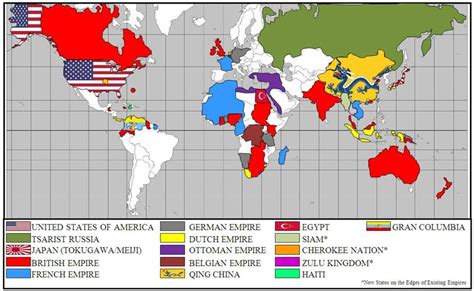
Causes of Imperialism
Economic Factors:

- Search for raw materials: European industries required access to raw materials such as rubber, oil, and minerals located in colonies.
- Expansion of markets: Colonies provided new markets for European manufactured goods, increasing profits.
- Capital accumulation: Surplus capital in Europe sought investment opportunities abroad.
Political Factors:
- Nationalism and prestige: Imperialism was seen as a way to increase national power and prestige.
- Balance of power: Countries competed to acquire colonies to keep pace with their rivals.
- Social Darwinism: The belief that some nations were superior to others justified colonialism as a way to spread civilization.
Forms of Imperialism
- Colony: A territory directly ruled by a foreign power.
- Protectorate: A territory where the local government is controlled by a foreign power.
- Sphere of influence: An area where a foreign power has exclusive economic and political privileges.
- Economic imperialism: Control over a region’s economy without direct political intervention.
Imperialism in Africa
Partition of Africa: By 1900, European powers had divided almost all of Africa among themselves.
- Congo: Belgian King Leopold II’s personal colony, known for its brutal exploitation of rubber.
- South Africa: British colony where the white minority imposed apartheid on the black majority.
- Trans-Saharan trade: European powers expanded their control over trade routes across the Sahara Desert.
Imperialism in Asia
- British India: The British Empire controlled the vast majority of the Indian subcontinent.
- Chinese concessions: European powers gained spheres of influence in China, leading to tensions and the Boxer Rebellion.
- Sino-Japanese War: Japan’s victory over China in 1895 marked the emergence of a new imperial power.
Imperialism in the Americas
- Cuba: U.S. intervention in the Spanish-American War led to the establishment of American control over Cuba.
- Panama: U.S. pressure forced Panama to grant the U.S. control of the Panama Canal Zone.
- Monroe Doctrine: The U.S. declared its opposition to European intervention in the Americas.
Impact of Imperialism
Positive Effects:
- Economic development: Imperial powers invested in infrastructure and education in colonies.
- Medical advancements: European doctors introduced new medicines and technologies, improving health.
- Cultural exchange: Imperialism facilitated the transfer of ideas and technology between cultures.
Negative Effects:
- Exploitation and oppression: Colonial powers exploited the resources and labor of their colonies.
- Political instability: Imperial rule often disrupted traditional political systems and created tensions.
- Environmental degradation: Imperialism led to deforestation, pollution, and other environmental problems.
Revolutions in the Global Age
Technological Revolutions:
- Industrial Revolution: New technologies such as the steam engine and the factory system transformed production.
- Agricultural Revolution: Improvements in farming techniques increased food production, leading to population growth.
- Transportation Revolution: Railways, steamships, and canals facilitated global trade and travel.
Social Revolutions:
- Urbanization: The Industrial Revolution attracted workers to cities, leading to overcrowding and social problems.
- Socialism and communism: Ideologies emerged that sought to address social inequality and economic exploitation.
- Rise of nationalism: Industrialization and urbanization strengthened national identities.
Political Revolutions:
- French Revolution (1789): Overthrew the monarchy and established a republic, inspiring revolutionary movements around the world.
- Latin American Revolutions (1810-1826): Independence movements led to the creation of new nations in the Americas.
- Russian Revolution (1917): Bolsheviks seized power and established the first communist state.
Impact of Revolutions
Positive Effects:
- Spread of democracy: Revolutions often resulted in the establishment of democratic governments.
- Social progress: Workers gained rights and benefits through labor movements and social reforms.
- Economic equality: Revolutions often challenged the traditional class structure and promoted social mobility.
Negative Effects:
- Violence and instability: Revolutions often involved violent conflict and political turmoil.
- Authoritarian regimes: Some revolutions led to the establishment of authoritarian governments that suppressed dissent.
- Economic disruption: Revolutions could disrupt trade and lead to economic hardship.
Tables
Table 1: Major European Colonies in Africa
| Colony | Colonizing Power |
|---|---|
| Algeria | France |
| Belgian Congo | Belgium |
| British Gold Coast (Ghana) | United Kingdom |
| French West Africa | France |
| German East Africa (Tanzania) | Germany |
Table 2: Imperialism in Asia
| Country | Colonizing Power |
|---|---|
| India | United Kingdom |
| China | France, Germany, Russia, United Kingdom, United States |
| Japan | Independent |
| Korea | Japan |
| Southeast Asia | France, Netherlands, United Kingdom, United States |
Table 3: Revolutions in the Global Age
| Revolution | Year |
|---|---|
| French Revolution | 1789 |
| Latin American Revolutions | 1810-1826 |
| Russian Revolution | 1917 |
| Chinese Revolution | 1949 |
| Cuban Revolution | 1959 |
Table 4: Impact of Imperialism and Revolutions
| Aspect | Imperialism | Revolutions |
|---|---|---|
| Economic | Exploitation, economic development | Social reform, economic equality |
| Political | Political instability, authoritarianism | Democracy, nationalism |
| Social | Oppression, social problems | Social progress, mobility |
| Cultural | Cultural exchange | Challenge to traditional values, spread of Western culture |