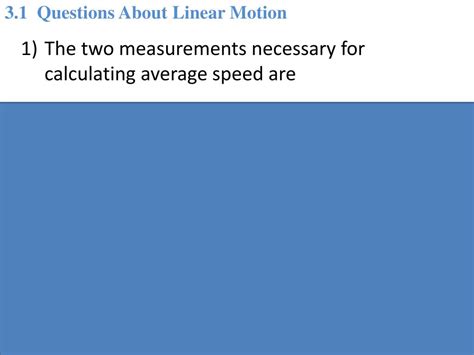
Calculating average speed is a fundamental skill in many areas, including physics, engineering, and sports. It is defined as the total distance traveled divided by the total time taken. To calculate average speed, you need only two measurements: distance and time.
Distance
Distance is a measure of the length of the path traveled. It can be measured in any unit of length, such as meters, kilometers, miles, or feet. The SI unit of distance is the meter (m).
Time
Time is a measure of the duration of an event. It can be measured in any unit of time, such as seconds, minutes, hours, or days. The SI unit of time is the second (s).
Formula for Average Speed
The formula for average speed is:
average speed = distance / time
For example, if you travel 100 kilometers in 2 hours, your average speed is 50 kilometers per hour.
Applications of Average Speed
Average speed is used in a wide variety of applications, including:
- Physics: Average speed is used to calculate the velocity of an object. Velocity is a vector quantity that has both magnitude (speed) and direction.
- Engineering: Average speed is used to design and operate machines and vehicles. For example, engineers use average speed to calculate the speed of a conveyor belt or the fuel efficiency of a car.
- Sports: Average speed is used to measure the performance of athletes. For example, runners use average speed to track their progress and improve their times.
Tips and Tricks for Calculating Average Speed
Here are a few tips and tricks for calculating average speed:
- Use the correct units. Make sure to use the same units for distance and time. For example, if you are measuring distance in kilometers and time in hours, your average speed will be in kilometers per hour.
- Be accurate. The more accurate your measurements of distance and time are, the more accurate your calculation of average speed will be.
- Use a calculator. If you are not comfortable with doing the calculations by hand, use a calculator to help you.
Common Mistakes to Avoid
Here are a few common mistakes to avoid when calculating average speed:
- Using the wrong units. Make sure to use the same units for distance and time. For example, do not use kilometers for distance and hours for time.
- Not being accurate. The more accurate your measurements of distance and time are, the more accurate your calculation of average speed will be.
- Forgetting to divide. The formula for average speed is distance divided by time. Do not forget to divide the distance by the time to get the average speed.
FAQs
Here are some frequently asked questions about average speed:
- What is the difference between average speed and velocity? Average speed is a scalar quantity that only has magnitude. Velocity is a vector quantity that has both magnitude (speed) and direction.
- How do I calculate the average speed of an object that is moving in a circle? To calculate the average speed of an object that is moving in a circle, you need to know the circumference of the circle and the time it takes the object to complete one revolution. The formula for average speed is:
average speed = circumference / time
- How do I calculate the average speed of an object that is accelerating? To calculate the average speed of an object that is accelerating, you need to know the initial speed, the final speed, and the time it takes the object to accelerate. The formula for average speed is:
average speed = (initial speed + final speed) / 2
Conclusion
Calculating average speed is a fundamental skill in many areas. By understanding the two measurements necessary for calculating average speed (distance and time), you can accurately calculate the average speed of any object.