The Intricate Tapestry of Linguistic Order
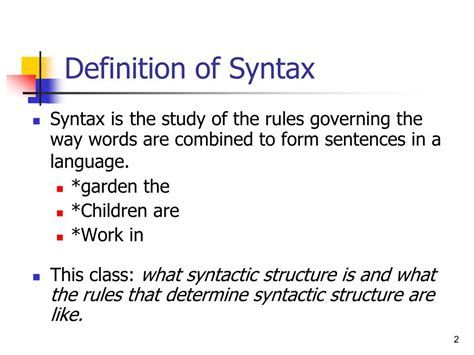
In the realm of language, the arrangement of words within sentences is not a matter of mere chance. Rather, it is governed by an intricate system of rules known as syntax. These rules dictate the permissible order of words, allowing for the construction of meaningful sentences that convey precise thoughts and ideas. Syntax, therefore, serves as the linchpin of sentence structure, ensuring clarity and coherence in human communication.

The study of syntax has captivated linguists for centuries, leading to the development of various theories and models that seek to explain the underlying principles governing word order. One influential approach is known as dependency grammar, which posits that every word in a sentence depends on another word either syntactically or semantically. By analyzing these dependencies, linguists can identify the hierarchical structure of a sentence and elucidate its grammatical relations.
Word Order Patterns: A Cross-Linguistic Perspective
The permissible order of words in sentences varies across languages, reflecting the diverse ways in which different cultures encode information. Studies by eminent linguists such as Joseph Greenberg and William Croft have identified several predominant word order patterns:
-
Subject-Verb-Object (SVO): The subject precedes the verb, which is followed by the object. English is a prime example of an SVO language.
-
Subject-Object-Verb (SOV): The subject precedes the object, which is followed by the verb. Japanese and Turkish are prominent SOV languages.
-
Verb-Subject-Object (VSO): The verb precedes the subject, which is followed by the object. Arabic and Irish are typical examples of VSO languages.
These word order patterns are not absolute, and variations exist within each language group. However, they provide a general framework for understanding the diverse ways in which languages order their constituents.
The Role of Context and Semantic Constraints
While syntax provides the fundamental rules governing word order, context and semantic constraints also play significant roles in shaping sentence structure. The meaning intended by the speaker or writer can influence the placement of words within a sentence, often overriding the default word order dictated by syntactic rules.
For instance, in English, the subject typically comes before the verb. However, in certain contexts, such as when emphasizing a particular element, the verb may precede the subject (e.g., “Never have I seen such a stunning sunset”).
Beyond Description: The Transformational Power of Syntax
Understanding the system of rules governing permissible word order in sentences is not merely an academic pursuit. It has far-reaching implications for various domains, including:
-
Natural Language Processing (NLP): NLP algorithms rely on syntactic analysis to extract meaning from text data. Accurate understanding of word order patterns is crucial for tasks such as machine translation, text summarization, and question answering.
-
Artificial Intelligence (AI): AI systems require a deep understanding of syntax to interpret and generate human language. By incorporating syntactic rules into AI models, researchers can enhance their ability to communicate and interact with humans.
-
Language Education: Explicit instruction on syntax can significantly improve language learners’ proficiency. By understanding the underlying rules of word order, learners can construct grammatically correct sentences and convey their ideas more effectively.
Conclusion
The system of rules governing permissible word order in sentences is a testament to the intricate complexities of human language. Syntax provides the scaffolding upon which sentences are built, allowing for the expression of countless thoughts, ideas, and emotions. Understanding these rules is essential not only for linguistic analysis but also for the advancement of fields such as NLP, AI, and language education. As linguists continue to delve into the intricacies of syntax, we gain deeper insights into the workings of the human mind and the boundless possibilities of human communication.