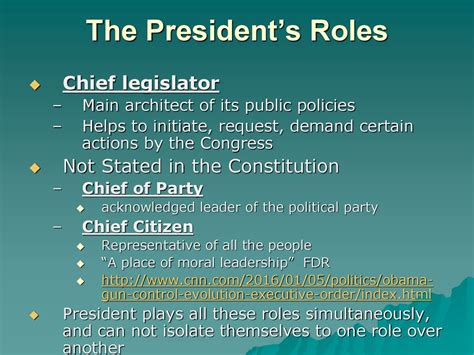
The President of the United States serves as the chief legislator in the federal government. The president’s role in the legislative process is to propose and sign bills into law. The president can also veto bills passed by Congress, which prevents them from becoming law.

The President’s Legislative Powers
The president has a number of powers that allow him or her to influence the legislative process. These powers include:
- The power to propose legislation. The president can propose legislation to Congress by submitting a bill to either the House of Representatives or the Senate.
- The power to sign bills into law. Once a bill has been passed by both the House and the Senate, it is sent to the president for his or her signature. If the president signs the bill, it becomes law.
- The power to veto bills. If the president does not approve of a bill, he or she can veto it. A vetoed bill is returned to Congress, which can override the veto with a two-thirds vote of both the House and the Senate.
The President’s Role in the Legislative Process
The president plays a key role in the legislative process. The president’s legislative agenda is often a major focus of debate in Congress. The president can also use his or her power to veto bills to shape the outcome of legislation.
In recent years, the president’s role in the legislative process has become increasingly important. This is due in part to the rise of partisan politics, which has made it more difficult for Congress to pass legislation. The president’s ability to veto bills gives him or her a great deal of power to shape the outcome of legislation.
The Challenges of Presidential Leadership
The president faces a number of challenges in exercising his or her legislative powers. These challenges include:
- The need to build consensus. The president must be able to build consensus among members of Congress in order to pass legislation. This can be difficult, especially in a partisan environment.
- The need to balance competing interests. The president must be able to balance the competing interests of different groups in order to pass legislation. This can be difficult, as different groups have different priorities.
- The need to manage the media. The president must be able to manage the media in order to build public support for his or her legislative agenda. This can be difficult, as the media can be critical of the president’s actions.
Conclusion
The president of the United States is a powerful figure in the legislative process. The president has the power to propose legislation, sign bills into law, and veto bills. The president also plays a key role in building consensus and managing the media. The president’s legislative powers are essential to the functioning of the federal government.