Introduction
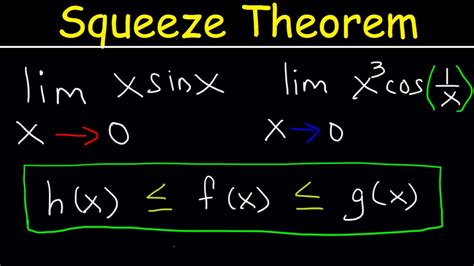
In calculus, the squeeze theorem, also known as the sandwich theorem, is a powerful tool for evaluating limits. It provides a way to determine the limit of a function by comparing it to two other functions with known limits. This technique is crucial for understanding advanced calculus concepts and has wide-ranging applications in various fields.

Squeeze Theorem Practice Problems
To master the squeeze theorem, it’s essential to practice solving a variety of problems. Here are several examples to hone your skills:
Problem 1:
Evaluate the limit:
lim x->0 (x^2 - 1) / (x - 1)
Problem 2:
Find the limit:
lim x->2 (sqrt(x) - sqrt(2)) / (x - 2)
Problem 3:
Determine the limit:
lim x->0 (sin(x) - x) / x^2
Problem 4:
Evaluate the limit:
lim x->pi/2 (1 - cos(x)) / (pi/2 - x)
Tips and Tricks
- Identify the inner and outer functions: The squeeze theorem involves comparing a function to two other functions. The function in question is often called the “inner function,” while the other two functions are known as the “outer functions.”
- Choose appropriate outer functions: The outer functions should have known limits that are equal to each other. This allows you to “squeeze” the inner function between the outer functions.
- Use algebraic manipulation: If necessary, simplify the inner and outer functions to make them easier to work with.
- Take the limit of the inner function: Once you have chosen appropriate outer functions, determine the limit of the inner function as the argument approaches the desired value.
- Check the outer function limits: Verify that the limits of the outer functions are indeed equal to each other. If they are not, the squeeze theorem cannot be applied.
Common Mistakes to Avoid
- Ignoring the limits of the outer functions: Failing to ensure that the limits of the outer functions are equal can lead to erroneous results.
- Using a function that is not continuous: The squeeze theorem requires that the inner function be continuous within the interval where the limit is being evaluated.
- Miscalculating the limit of the inner function: Incorrectly determining the limit of the inner function can result in an inaccurate overall limit.
- Applying the squeeze theorem incorrectly: It’s important to understand the conditions under which the squeeze theorem can be used. Misapplying it can lead to false conclusions.
Applications of the Squeeze Theorem
The squeeze theorem finds applications in various fields, including:
- Engineering: Analyzing the behavior of complex systems and predicting their responses.
- Physics: Modeling physical phenomena, such as the motion of objects and the transfer of energy.
- Finance: Evaluating limits of financial functions and assessing investment risks.
- Medicine: Studying the concentration of drugs in the body and determining effective dosages.
Conclusion
Mastering the squeeze theorem is crucial for understanding advanced calculus and applying it to real-world problems. By practicing the problems provided and incorporating the tips and tricks outlined above, you can improve your ability to solve squeeze theorem problems and enhance your overall mathematical skills. Remember to avoid common mistakes and explore the wide-ranging applications of this powerful technique.