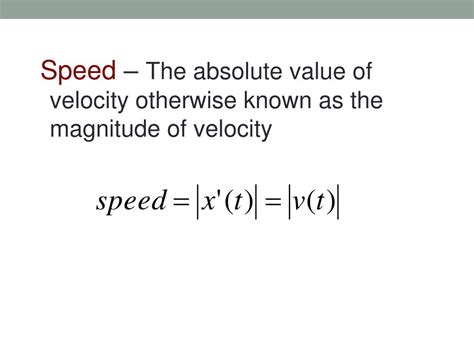
In physics, speed is a scalar quantity that refers to the rate at which an object is moving. Velocity, on the other hand, is a vector quantity that refers to the rate at which an object is moving in a specific direction. The absolute value of velocity is equal to the speed of the object.
Understanding Speed and Velocity
Speed is a measure of how fast an object is moving, regardless of its direction. It is calculated by dividing the distance traveled by the time taken to travel that distance. Velocity, on the other hand, is a measure of how fast an object is moving in a specific direction. It is calculated by dividing the displacement (the change in position) by the time taken to make that displacement.
The absolute value of velocity is equal to the speed of the object because it is the magnitude of the velocity vector. The magnitude of a vector is its length, and it is always a positive number. Therefore, the absolute value of velocity is always a positive number, regardless of the direction of the velocity vector.
Applications of Speed and Velocity
Speed and velocity are important concepts in physics and engineering. They are used to describe the motion of objects in a variety of applications, including:
- Automotive engineering: Speed and velocity are used to design vehicles that can travel at safe and efficient speeds.
- Aerospace engineering: Speed and velocity are used to design aircraft and spacecraft that can travel at high speeds and altitudes.
- Robotics: Speed and velocity are used to design robots that can move quickly and accurately.
- Sports: Speed and velocity are used to measure the performance of athletes in a variety of sports, such as running, swimming, and cycling.
Speed and Velocity in Everyday Life
Speed and velocity are also important concepts in everyday life. We use them to describe the motion of objects all around us, such as:
- The speed of a car: We use the speedometer in our cars to measure the speed at which we are traveling.
- The velocity of a river: We can use the velocity of a river to determine how quickly it is flowing.
- The speed of a sound: We can use the speed of sound to determine how far away a sound is traveling.
Conclusion
Speed and velocity are two important concepts in physics and engineering. They are used to describe the motion of objects in a variety of applications, from automotive engineering to sports. Speed and velocity are also important concepts in everyday life, as we use them to describe the motion of objects all around us.
Additional Information
1. Table of Speed and Velocity Units
| Unit | Abbreviation | Definition |
|---|---|---|
| Meter per second | m/s | The distance traveled per unit time |
| Kilometer per hour | km/h | The distance traveled per unit time |
| Mile per hour | mph | The distance traveled per unit time |
| Knot | kn | The speed of a ship |
2. Table of Speed and Velocity Conversion Factors
| Conversion | Factor |
|---|---|
| m/s to km/h | Multiply by 3.6 |
| km/h to m/s | Divide by 3.6 |
| mph to km/h | Multiply by 1.60934 |
| km/h to mph | Divide by 1.60934 |
| kn to m/s | Multiply by 1.852 |
| m/s to kn | Divide by 1.852 |
3. Table of Applications of Speed and Velocity
| Application | Speed or Velocity |
|---|---|
| Automotive engineering | Speed and velocity |
| Aerospace engineering | Speed and velocity |
| Robotics | Speed and velocity |
| Sports | Speed and velocity |
| Everyday life | Speed and velocity |
4. Table of Benefits of Knowing Speed and Velocity
| Benefit | Description |
|---|---|
| Improved safety | Speed and velocity can be used to design vehicles that can travel at safe and efficient speeds. |
| Increased efficiency | Speed and velocity can be used to design vehicles that can travel at high speeds and altitudes. |
| Enhanced accuracy | Speed and velocity can be used to design robots that can move quickly and accurately. |
| Improved performance | Speed and velocity can be used to measure the performance of athletes in a variety of sports. |
| Greater understanding of the world around us | Speed and velocity can be used to describe the motion of objects all around us. |