Introduction
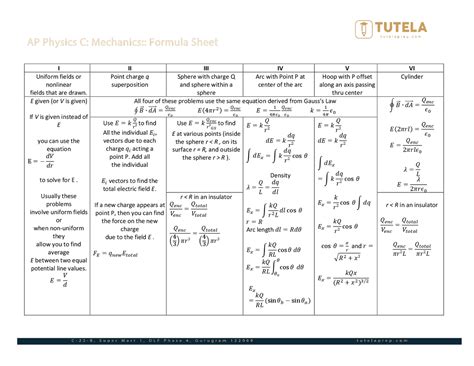
Physics mechanics is a fundamental branch of physics that deals with the motion of objects and the forces that act upon them. Understanding mechanics is essential for a wide range of scientific disciplines, including engineering, astronomy, and biology. This formula sheet provides a comprehensive reference to key concepts and equations in mechanics, covering topics such as kinematics, dynamics, and statics.

Kinematics
Kinematics describes the motion of objects without considering the forces that cause the motion.
Linear Kinematics
- Displacement: $$\Delta x = x_f – x_i$$
- Average velocity: $$\overline{v} = \frac{\Delta x}{\Delta t}$$
- Instantaneous velocity: $$v = \frac{d}{dt}x$$
- Acceleration: $$a = \frac{d}{dt}v$$
- Constant acceleration equation: $$x_f = x_i + v_it + \frac{1}{2}at^2$$
Rotational Kinematics
- Angular displacement: $$\Delta \theta = \theta_f – \theta_i$$
- Average angular velocity: $$\overline{\omega} = \frac{\Delta \theta}{\Delta t}$$
- Instantaneous angular velocity: $$\omega = \frac{d}{dt}\theta$$
- Angular acceleration: $$\alpha = \frac{d}{dt}\omega$$
- Constant angular acceleration equation: $$\theta_f = \theta_i + \omega_it + \frac{1}{2}\alpha t^2$$
Dynamics
Dynamics considers the relationship between forces, mass, and motion.
Newton’s Laws of Motion
- First law: An object at rest will remain at rest, and an object in motion will continue moving at a constant velocity unless acted upon by an unbalanced force.
- Second law: The acceleration of an object is directly proportional to the net force acting on the object and inversely proportional to its mass. $$F = ma$$
- Third law: For every action, there is an equal and opposite reaction.
Work and Energy
- Work: $$W = Fd$$
- Kinetic energy: $$K = \frac{1}{2}mv^2$$
-
Potential energy:
- Gravitational potential energy: $$U_g = mgh$$
- Elastic potential energy: $$U_e = \frac{1}{2}kx^2$$
- Conservation of energy: The total energy of an isolated system remains constant.
Momentum
- Linear momentum: $$p = mv$$
- Angular momentum: $$L = I\omega$$
- Conservation of momentum: The total linear momentum of an isolated system remains constant.
Statics
Statics deals with objects at rest or in equilibrium.
Equilibrium
- An object is in equilibrium if the net force acting on it is zero.
- ΣF = 0
Moment of Inertia
- Moment of inertia for a point mass: $$I = mr^2$$
- Moment of inertia for a solid cylinder: $$I = \frac{1}{2}MR^2$$
Torque
- Torque: $$\tau = rF$$
- Equilibrium for a rigid body: Στ = 0
Applications
The principles of mechanics have countless applications in various fields, including:
- Engineering: Design of bridges, buildings, and machines
- Aerospace: Flight dynamics and spacecraft engineering
- Medicine: Motion analysis for prosthetics and rehabilitation
- Robotics: Control and motion planning
- Sports: Optimization of athletic performance
Common Mistakes to Avoid
- Confusing displacement with distance
- Neglecting air resistance in motion calculations
- Using the wrong units for acceleration
- Incorrectly applying Newton’s third law
- Forgetting to include gravitational potential energy in energy conservation problems
FAQs
-
What is the difference between speed and velocity?
- Speed is the scalar magnitude of velocity, while velocity is a vector quantity that includes both magnitude and direction.
-
How do you determine the force acting on an object?
- Use Newton’s second law (F = ma) by measuring the mass of the object and its acceleration.
-
What is the significance of the moment of inertia?
- It determines the resistance of an object to angular acceleration.
-
How do you calculate the work done by a non-constant force?
- Use the integral of force with respect to displacement, W = ∫Fdx.
-
What are the conditions for equilibrium?
- The net force and net torque acting on the object must be zero.
Conclusion
This formula sheet provides a comprehensive reference to key concepts and equations in physics mechanics. Understanding these principles is essential for studying a wide range of scientific disciplines. By applying these formulas correctly and avoiding common mistakes, students can confidently tackle mechanics problems and develop a strong foundation in physics.