Introduction
In the realm of statistics, understanding the distinctions between observational studies and experiments is paramount for conducting robust research and drawing valid conclusions. Both methods serve as key tools for uncovering patterns and relationships within data, but they differ significantly in their approaches and inferences. This article will delve into the fundamental differences between observational studies and experiments, highlighting their respective strengths and limitations to empower AP Statistics students and researchers with a comprehensive understanding of these crucial research methodologies.

Key Characteristics of Observational Studies
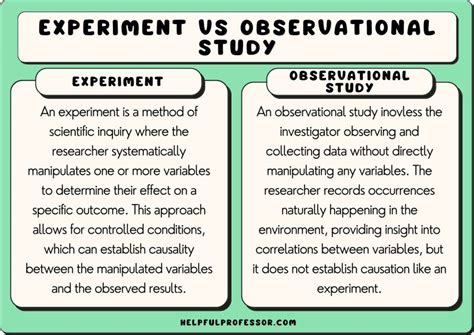
Observational studies, as the name suggests, involve observing and collecting data on a group of subjects or participants without actively intervening or manipulating any variables. They primarily aim to identify correlations and associations between variables, often in real-world settings.
Types of Observational Studies
- Cohort Studies: Follow a group of individuals over time, observing their exposures and outcomes.
- Case-Control Studies: Compare individuals with a particular outcome (cases) to those without it (controls), looking for differences in prior exposures.
- Cross-Sectional Studies: Collect data from a representative sample at a single point in time.
Strengths of Observational Studies
- Real-World Applicability: Capture data in natural settings, providing insights into real-world phenomena.
- Generalizability: Can potentially yield findings applicable to a broader population.
- Lower Cost and Time: Often less expensive and time-consuming than experiments.
Limitations of Observational Studies
- Confounding Variables: External factors can influence outcomes, making it difficult to determine cause-and-effect relationships.
- Bias: Data collection and interpretation can be influenced by biases, affecting the validity of results.
- Observational Nature: Researchers cannot control or manipulate variables, limiting the ability to establish causality.
Key Characteristics of Experiments
Experiments, in contrast to observational studies, involve actively manipulating or controlling one or more independent variables to observe their effects on a dependent variable. They provide a more stringent approach to testing hypotheses and establishing cause-and-effect relationships.
Types of Experiments
- True Experiments: Involve random assignment of participants to different treatment groups, ensuring unbiased comparisons.
- Quasi-Experiments: Use non-random assignment but attempt to control for confounding variables.
- Factorial Experiments: Test the effects of multiple independent variables simultaneously.
Strengths of Experiments
- Causal Inference: Control over variables allows for strong inferences of causality.
- Reduced Bias: Random assignment minimizes bias in treatment group comparisons.
- Generalizability: Findings can often be generalized to other similar populations.
Limitations of Experiments
- Cost and Time: Can be expensive and time-consuming to conduct.
- Artificiality: May not fully capture real-world conditions, potentially affecting the applicability of results.
- Ethical Concerns: Interventions may raise ethical considerations, especially in human studies.
Choosing the Right Method
The choice between an observational study and an experiment depends on the specific research question and the available resources.
- Observational Study: Suitable for exploratory research, identifying correlations, and gaining insights into real-world phenomena.
- Experiment: Appropriate for testing hypotheses and establishing cause-and-effect relationships, especially when strong control over variables is feasible.
Examples of Applications
Observational Studies
- National Health and Nutrition Examination Survey (NHANES): A large-scale observational study providing data on the health and nutritional status of the U.S. population.
- Framingham Heart Study: A long-term observational study that has identified risk factors for cardiovascular disease.
- Cancer Prevention Study II Nutrition Cohort: An observational study linking dietary factors to cancer incidence.
Experiments
- Randomized Controlled Trial (RCT): A clinical trial that assigns patients to active treatment or placebo groups randomly, testing the efficacy of a new drug or intervention.
- Agricultural Field Experiment: An experiment that manipulates crop treatments (e.g., fertilizer, water) to study their effects on yield.
- Psychological Laboratory Experiment: An experiment that investigates the effects of psychological variables on behavior, often in a controlled laboratory setting.
Conclusion
Observational studies and experiments are invaluable tools in the arsenal of researchers, offering complementary approaches to uncovering insights from data. Observational studies provide valuable information on real-world phenomena but face limitations in establishing causality. Experiments, while more expensive and time-consuming, provide stronger evidence for cause-and-effect relationships. Understanding the differences between these methods empowers researchers to choose the most appropriate approach for their research endeavors, leading to more robust and informative conclusions.