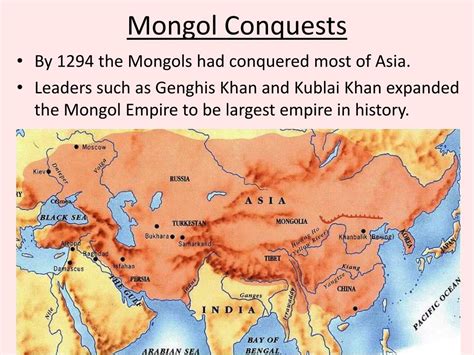
The Mongol Empire, spanning the 13th and 14th centuries, stands as one of history’s colossal and transformative empires. Its reach extended from the Pacific Ocean in the east to Eastern Europe in the west, encompassing an area of over 24 million square kilometers. This vast empire’s legacy continues to resonate today, shaping global history, politics, and culture.

Genesis of the Mongol Empire
The Mongol Empire originated in the vast steppes of Central Asia, where a nomadic confederacy of tribes roamed. Under the leadership of Genghis Khan, these disparate tribes were united in 1206, forming a formidable force known as the Mongol Horde.
Genghis Khan’s military prowess, strategic acumen, and ruthless ambition laid the foundation for the empire’s rapid expansion. His successors, such as Ögedei Khan and Kublai Khan, continued his conquests, extending the empire to its zenith.
Mongol Military Might
The Mongol army was renowned for its exceptional mobility, discipline, and lethal tactics. Cavalry was the backbone of their forces, enabling them to swiftly traverse vast distances and execute lightning-fast raids. Mongol warriors were also adept at using composite bows, siege warfare, and psychological intimidation.
Conquests and Campaigns
The Mongol Empire’s territorial expansion was swift and devastating. By 1258, they had conquered most of Eurasia, stretching from Korea in the east to Hungary in the west. Mongol armies marched across Central Asia, the Middle East, Eastern Europe, and even into Southeast Asia.
The Mongols’ military campaigns caused immense devastation, leaving behind a trail of destruction and bloodshed. However, their conquests also facilitated the exchange of ideas, technologies, and trade between disparate regions, fostering cultural diffusion and globalization.
Table 1: Mongol Conquests and Key Battles
| Conquest | Key Battle | Year |
|---|---|---|
| Central Asia | Battle of Yehuling | 1211 |
| North China | Battle of Baideng Mountain | 1211 |
| Khwarazmian Empire | Battle of Samarkand | 1220 |
| Russia | Battle of the Kalka River | 1223 |
| Eastern Europe | Battle of Legnica | 1241 |
| Persia | Siege of Baghdad | 1258 |
| Southern China | Battle of Yashan | 1279 |
Mongol Rule
The Mongol Empire was a highly centralized and autocratic state. The khan, or emperor, held absolute power and commanded a vast bureaucracy that administered the empire. Mongol rule was often characterized by harsh punishments, enforced through a strict legal code known as the Yassa.
However, the Mongols also promoted religious tolerance, allowing for the coexistence of Buddhism, Islam, Christianity, and other faiths within their empire. They also established a vast network of trade routes, known as the Pax Mongolica, which facilitated the exchange of goods and ideas between Europe and Asia.
Legacy and Impact
The Mongol Empire left an enduring legacy on world history. Its conquests reshaped political boundaries and established new cultural and economic connections. The empire’s political system, military tactics, and technological innovations influenced subsequent empires and societies.
Table 2: Innovations and Legacies of the Mongol Empire
| Innovation | Legacy |
|---|---|
| Composite bow | Improved archery technology |
| Stirrup | Enhanced cavalry effectiveness |
| Gunpowder | Introduced to Europe from China |
| Paper money | Standardized currency system |
| Postal system | Facilitated communication and administration |
| Religious tolerance | Promoted cultural diversity |
Table 3: Mongol Empire’s Impact on Eurasian History
| Region | Impact |
|---|---|
| Central Asia | Political unification and economic revitalization |
| China | Yuan Dynasty established, leading to cultural exchange |
| Middle East | Islamic caliphates conquered, weakening Abbasid power |
| Russia | Golden Horde established, leading to Russian expansion |
| Eastern Europe | Depopulation and political fragmentation |
| Europe | End of Silk Road trade and rise of maritime trade routes |
Conclusion
The Mongol Empire was a transformative force in world history. Its conquests reshaped the political landscape of Eurasia, fostered cultural exchange, and stimulated economic growth. The empire’s military prowess, administrative efficiency, and innovative technologies left a lasting legacy on civilizations around the globe.
The study of the Mongol Empire continues to shed light on the interconnectedness of human history. It reminds us of the fragility of empires, the power of military might, and the resilience of human culture.