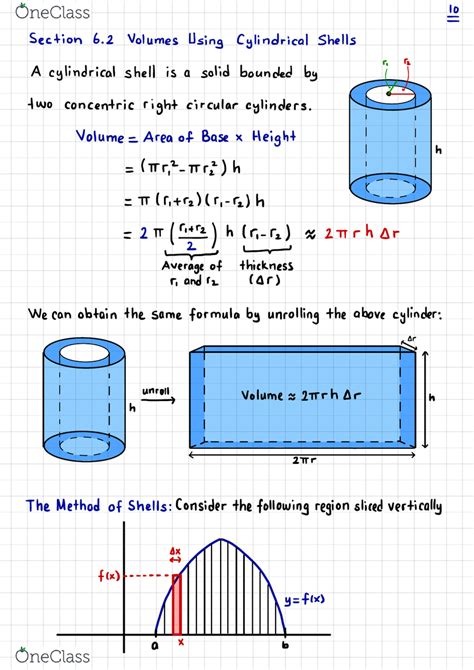
The method of cylindrical shells is a powerful technique used in calculus to determine the volume of a solid of revolution. This method involves integrating the circumference of a cylindrical shell multiplied by its height to obtain the volume of the solid.

Understanding the Method of Cylindrical Shells
Consider a function f(x) that is continuous on an interval [a, b]. When rotated about the y-axis, this function generates a solid of revolution. The method of cylindrical shells involves dividing the solid into an infinite number of cylindrical shells, each with a radius of x, height of f(x), and thickness of dx.
The volume of each cylindrical shell is given by:
dV = 2πx f(x) dx
where 2πx represents the circumference of the cylindrical shell at a distance x from the y-axis.
To determine the total volume of the solid of revolution, we integrate this expression over the interval [a, b]:
V = ∫[a, b] 2πx f(x) dx
Step-by-Step Application of the Method
- Sketch the Region: Draw the graph of the function f(x) and the region of revolution on the y-axis.
- Identify the Axis of Rotation: Determine the axis about which the function is rotated to generate the solid of revolution.
- Set Up the Integral: Write the integral for the volume using the formula above.
- Evaluate the Integral: Compute the integral to determine the total volume of the solid.
Benefits of Using the Method of Cylindrical Shells
- Accuracy: Provides an accurate method for calculating volumes of complicated solids of revolution.
- Simplicity: The method is relatively simple to apply compared to other techniques such as washer method or disk method.
- Versatile: Can be applied to a wide range of functions and regions of revolution.
Applications of the Method of Cylindrical Shells
- Architectural Design: Determining the volume of buildings, domes, and other curved structures.
- Manufacturing: Calculating the volume of tanks, pipes, and other cylindrical objects.
- Medical Imaging: Measuring the volume of cells, organs, and other biological structures from medical scans.
Tips and Tricks for Using the Method
- Choose the Correct Axis: Ensure that the axis of rotation is perpendicular to the axis of integration.
- Handle Discontinuities: If f(x) has discontinuities, break the region of revolution into smaller intervals.
- Use Symmetry: If the function or region has symmetry, utilize it to simplify the integration.
Tables for Volume Calculations
| Shape | Formula |
|---|---|
| Cylinder | V = πr²h |
| Cone | V = (1/3)πr²h |
| Sphere | V = (4/3)πr³ |
| Torus | V = 2π²R²r |
Conclusion
The method of cylindrical shells provides a powerful tool for calculating the volume of solids of revolution. By understanding the concept, applying the method correctly, and leveraging its benefits, engineers, scientists, and researchers can accurately determine the volume of complex objects in various fields.