The period from 1200 to 1450 was a time of great political and military upheaval in Asia. The Mongol Empire, founded by Genghis Khan in 1206, rapidly expanded across the continent, conquering vast territories and establishing one of the largest empires in history. Other major empires that emerged during this period included the Delhi Sultanate in India, the Yuan Dynasty in China, and the Timurid Empire in Central Asia.

Mongol Empire
The Mongol Empire was founded by Genghis Khan in 1206. Genghis Khan was a brilliant military leader who united the Mongol tribes and led them to conquer vast territories across Asia. The Mongol Empire reached its peak under Kublai Khan, who established the Yuan Dynasty in China in 1271. The Yuan Dynasty ruled over China for nearly a century, and during this time, China experienced a period of great economic and cultural prosperity.
Delhi Sultanate
The Delhi Sultanate was founded in 1206 by Qutb-ud-din Aibak, a former slave general who served under Muhammad Ghori, the founder of the Ghurid Dynasty. The Delhi Sultanate ruled over much of northern India and parts of present-day Pakistan and Bangladesh. The Delhi Sultanate was a major center of Islamic culture and scholarship, and it produced some of the most important works of Islamic literature and architecture.
Yuan Dynasty
The Yuan Dynasty was founded by Kublai Khan in 1271. Kublai Khan was a grandson of Genghis Khan, and he established the Yuan Dynasty after conquering China. The Yuan Dynasty ruled over China for nearly a century, and during this time, China experienced a period of great economic and cultural prosperity. The Yuan Dynasty was a major patron of the arts, and it produced some of the most important works of Chinese literature and art.
Timurid Empire
The Timurid Empire was founded by Timur, also known as Tamerlane, in 1370. Timur was a brilliant military leader who conquered vast territories across Central Asia. The Timurid Empire reached its peak under Timur’s grandson, Shah Rukh, who ruled over a vast empire that included parts of present-day Iran, Iraq, Afghanistan, Uzbekistan, and Kazakhstan. The Timurid Empire was a major center of Islamic culture and scholarship, and it produced some of the most important works of Islamic literature and architecture.
Other Empires
In addition to the four major empires mentioned above, there were a number of other empires that emerged in Asia during the 1200-1450 period. These included:
- The Khmer Empire in Southeast Asia
- The Champa Kingdom in Vietnam
- The Majapahit Empire in Indonesia
- The Ayutthaya Kingdom in Thailand
- The Lan Xang Kingdom in Laos
Table of Empires
| Empire | Founder | Founded | Territory |
|---|---|---|---|
| Mongol Empire | Genghis Khan | 1206 | China, Central Asia, Persia, Russia |
| Delhi Sultanate | Qutb-ud-din Aibak | 1206 | Northern India, Pakistan, Bangladesh |
| Yuan Dynasty | Kublai Khan | 1271 | China, Mongolia, Korea |
| Timurid Empire | Timur | 1370 | Central Asia, Iran, Iraq, Afghanistan, Uzbekistan, Kazakhstan |
Timeline of Empires
| Year | Event |
|---|---|
| 1206 | Genghis Khan founds the Mongol Empire |
| 1206 | Qutb-ud-din Aibak founds the Delhi Sultanate |
| 1271 | Kublai Khan establishes the Yuan Dynasty in China |
| 1370 | Timur founds the Timurid Empire |
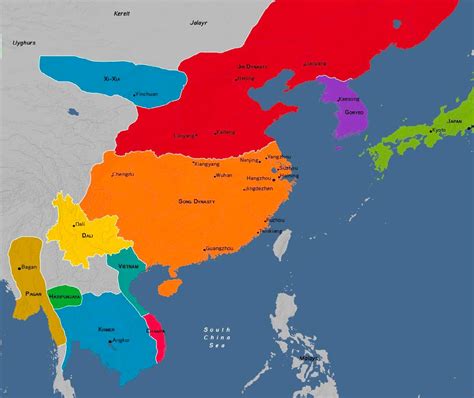
Map of Empires
[Image of a map of Asia in the 1200-1450 period, showing the major empires]
Conclusion
The period from 1200 to 1450 was a time of great political and military upheaval in Asia. The Mongol Empire, founded by Genghis Khan, rapidly expanded across the continent