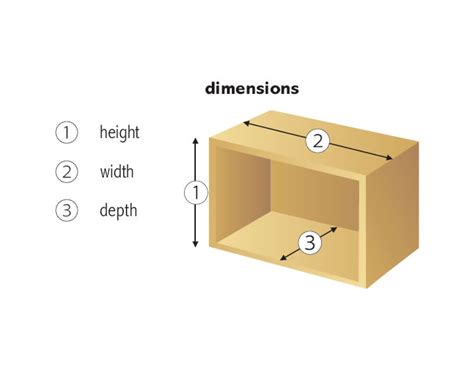
When it comes to describing the dimensions of an object or space, you’ve likely encountered the terms “height” and “width.” But have you ever wondered about the correct order in which to write these measurements? Is it height x width (h x w) or width x height (w x h)?
Knowing the correct order for height and width is crucial in various fields, including:
- Architecture and Interior Design: To accurately plan and construct buildings, architects and interior designers rely on precise measurements.
- Manufacturing: Proper dimensions are essential for creating products that fit their intended purpose and meet industry standards.
- Photography and Graphic Design: Image resolution and aspect ratios require accurate height and width specifications.
- Data Analysis and Visualization: Statistical data and charts often include height and width measurements for accuracy.
According to the International Organization for Standardization (ISO) and the American National Standards Institute (ANSI), the standard convention for writing dimensions is width x height (w x h). This order is used in numerous industries and applications:
- Building Codes: Construction professionals refer to dimensions as width x height for building floor plans and specifications.
- Product Packaging: Boxes and other product packaging display width x height measurements, indicating the width as the first dimension.
- Image Resolutions: Camera specifications and image editing software use width x height to describe image size, e.g., 1920 x 1080 pixels.
- Spreadsheet Cells: Excel and other spreadsheet programs use width x height to represent cell sizes.
While the w x h convention is widely adopted, some argue for using height x width (h x w). They contend that height is the primary measurement when describing objects or spaces, as it is the vertical dimension that we typically notice first.
Note: The h x w convention is not widely used in standardized documentation and professional settings, but it may be encountered in specific contexts.
There are a few exceptions to the w x h rule:
- Art and Canvas Painting: In the art world, measurements are traditionally given as height x width, reflecting the orientation of the canvas.
- Hanging Pictures: Picture frames are usually described using width x height, with the width representing the horizontal length from left to right.
- Always check style guides and industry standards for the appropriate format when writing dimensions.
- Use consistent units of measurement (e.g., inches, centimeters) throughout your project.
- Verify measurements carefully to ensure accuracy, especially when working with critical dimensions.
- Determine the standard convention (w x h) or exception (h x w) applicable to your context.
- Measure the width of the object or space using an appropriate tool.
- Measure the height of the object or space.
- Write the dimensions in the correct order: width x height (w x h) or height x width (h x w).
-
Which is the correct way to write dimensions for a building floor plan?
– w x h (width x height) -
How are image resolutions displayed?
– w x h (width x height) -
Is it okay to use h x w in any context?
– No, it’s not widely adopted in standardized documentation and professional settings, except for art and painting. -
What unit of measurement should I use for dimensions?
– Consistent units throughout your project, such as inches, centimeters, or meters. -
Is the width always the first dimension?
– Yes, according to the ISO and ANSI standards, except for art and picture frames. -
How can I find out the correct format for dimensions?
– Refer to style guides, industry standards, or consult with experts in the field.
Understanding the correct order for height and width (w x h) is crucial for accuracy and consistency in various fields. By following the established standards and conventions, you can ensure effective communication and prevent errors. Whether you’re a designer, engineer, or simply describing an object, use this knowledge to write dimensions correctly every time.