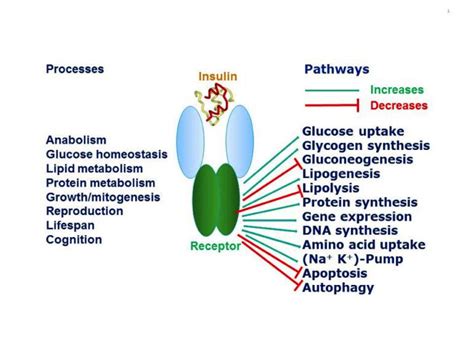
Insulin is a hormone produced by the pancreas that plays a crucial role in regulating blood sugar levels. When insulin binds to its receptor on target cells, it triggers a cascade of events that ultimately leads to glucose uptake and utilization by cells. This process is essential for maintaining energy homeostasis in the body.

Mechanism of Action
When insulin binds to its receptor on target cells, it triggers a conformational change in the receptor that activates its intracellular tyrosine kinase domain. This activation leads to the phosphorylation of insulin receptor substrate proteins (IRS), which in turn activate downstream signaling pathways.
Two main downstream signaling pathways activated by insulin are the phosphatidylinositol 3-kinase (PI3K) pathway and the mitogen-activated protein kinase (MAPK) pathway. The PI3K pathway is involved in glucose uptake and metabolism, while the MAPK pathway is involved in cell growth and differentiation.
Effects of Insulin Binding on Target Cells
Insulin binding to its receptor on target cells has several important effects, including:
- Glucose uptake: Insulin stimulates glucose uptake by cells, particularly in skeletal muscle, adipose tissue, and liver cells. This is mediated by the translocation of glucose transporter proteins (GLUT4) to the cell surface.
- Glycogen synthesis: Insulin promotes glycogen synthesis in liver and skeletal muscle cells. This is mediated by the activation of glycogen synthase, which converts glucose to glycogen for storage.
- Lipogenesis: Insulin stimulates lipogenesis in adipose tissue. This is mediated by the activation of lipogenic enzymes, which convert glucose to fatty acids.
- Protein synthesis: Insulin stimulates protein synthesis in skeletal muscle and other tissues. This is mediated by the activation of mTOR, a kinase that promotes cell growth.
Clinical Significance
Insulin binding to its receptor is crucial for maintaining normal blood sugar levels. In type 1 diabetes, the body does not produce insulin, while in type 2 diabetes, the body does not respond to insulin properly. Both conditions can lead to high blood sugar levels, which can damage blood vessels and organs over time.
Insulin therapy is the mainstay of treatment for diabetes. Insulin can be administered by injection or through an insulin pump. By replacing or supplementing the body’s own insulin, insulin therapy can help to lower blood sugar levels and prevent complications.
Future Applications
Insulin binding to its receptor is a complex process that is still being studied. Researchers are investigating new uses for insulin and its analogs, such as:
- Treatment of obesity: Insulin analogs that selectively activate the PI3K pathway may be useful for treating obesity by promoting fat loss.
- Cancer treatment: Insulin analogs that selectively activate the MAPK pathway may be useful for treating cancer by inhibiting cell growth and proliferation.
- Neurodegenerative diseases: Insulin signaling has been implicated in the development and progression of neurodegenerative diseases such as Alzheimer’s disease and Parkinson’s disease. Insulin analogs that enhance insulin signaling in the brain may be useful for treating these diseases.
Conclusion
Insulin binding to its receptor on target cells is a vital process for maintaining normal blood sugar levels and energy homeostasis. Insulin therapy is an important treatment for diabetes. Researchers are continuing to study insulin signaling, with the goal of developing new applications for insulin and its analogs.
| Effect of Insulin Binding on Target Cells | Mechanism |
|---|---|
| Glucose uptake | Translocation of GLUT4 to cell surface |
| Glycogen synthesis | Activation of glycogen synthase |
| Lipogenesis | Activation of lipogenic enzymes |
| Protein synthesis | Activation of mTOR |
| Insulin Analogs | Uses |
|---|---|
| PI3K-selective analogs | Treatment of obesity |
| MAPK-selective analogs | Cancer treatment |
| Brain-penetrating analogs | Neurodegenerative diseases |
- What is the difference between type 1 and type 2 diabetes?
- In type 1 diabetes, the body does not produce insulin, while in type 2 diabetes, the body does not respond to insulin properly.
- How is diabetes treated?
- Insulin therapy is the mainstay of treatment for diabetes. Insulin can be administered by injection or through an insulin pump.
- What are the complications of diabetes?
- High blood sugar levels can damage blood vessels and organs over time, leading to complications such as heart disease, stroke, kidney disease, and blindness.
- Can diabetes be prevented?
- While there is no sure way to prevent diabetes, there are things you can do to reduce your risk, such as maintaining a healthy weight, eating a healthy diet, and getting regular exercise.
- What is the role of insulin signaling in cancer?
- Insulin signaling has been implicated in the development and progression of cancer. Insulin analogs that selectively activate the MAPK pathway may be useful for treating cancer by inhibiting cell growth and proliferation.
- What is the future of insulin therapy?
- Researchers are continuing to study insulin signaling, with the goal of developing new applications for insulin and its analogs. This includes the development of more effective and targeted therapies for diabetes and other diseases.