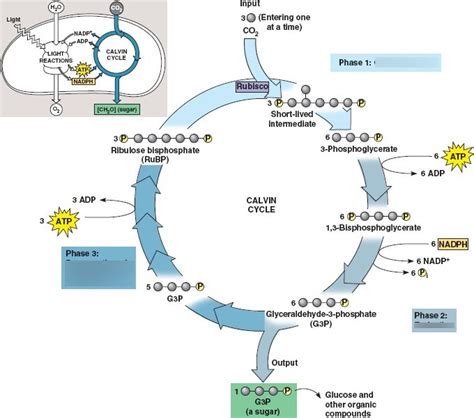
The Calvin cycle, also known as the light-independent reactions of photosynthesis, is a crucial biochemical process that occurs in the stroma of chloroplasts. In this cycle, carbon dioxide is converted into organic compounds, primarily glucose, using energy from ATP and NADPH generated during the light-dependent reactions.
Inputs of the Calvin Cycle
- Carbon dioxide (CO2): The main substrate of the Calvin cycle, CO2 is captured from the atmosphere.
- ATP (adenosine triphosphate): The energy currency of the cell, ATP provides the energy needed to drive the chemical reactions of the cycle.
- NADPH (nicotinamide adenine dinucleotide phosphate): The reducing agent of the cycle, NADPH provides the electrons needed to convert CO2 into organic compounds.
Outputs of the Calvin Cycle
- Glucose (C6H12O6): The primary product of the Calvin cycle, glucose is a six-carbon sugar that serves as an energy source for the plant.
- Glyceraldehyde-3-phosphate (G3P): An intermediate product of the Calvin cycle, G3P is a three-carbon molecule that can be used to synthesize other organic compounds, such as sucrose and starch.
- Oxygen (O2): A byproduct of the Calvin cycle, O2 is released into the atmosphere.
The Role of the Calvin Cycle in Photosynthesis
The Calvin cycle plays a fundamental role in photosynthesis by converting inorganic carbon (CO2) into organic compounds (sugars). This process is essential for life on Earth, as it provides the primary energy source for plants and other photosynthetic organisms. The products of the Calvin cycle are used for growth, reproduction, and respiration, contributing to the overall health and productivity of plants.
The Calvin cycle consists of three main phases: carbon fixation, reduction, and regeneration.
Phase 1: Carbon Fixation
- The enzyme ribulose-1,5-bisphosphate carboxylase/oxygenase (Rubisco) catalyzes the reaction between CO2 and ribulose-1,5-bisphosphate (RuBP), forming two molecules of 3-phosphoglycerate (3-PGA).
Phase 2: Reduction
- The 3-PGA molecules are reduced to glyceraldehyde-3-phosphate (G3P) using ATP and NADPH.
Phase 3: Regeneration
- One molecule of G3P exits the cycle as the final product, while the remaining five G3P molecules are rearranged and converted back to RuBP, which is used to start the cycle anew.
The Calvin cycle is a fundamental process in photosynthesis, which has numerous applications in agriculture, biotechnology, and environmental science:
- Crop Improvement: Understanding the Calvin cycle can lead to the development of plants with higher photosynthetic rates and improved crop yields.
- Biofuel Production: The Calvin cycle is the basis for the production of biofuels, such as ethanol and biodiesel, from plant biomass.
- Carbon Sequestration: The Calvin cycle plays a role in carbon sequestration, removing CO2 from the atmosphere and storing it in plant tissues.
- Bioremediation: The Calvin cycle is involved in the bioremediation of contaminated environments, as it can degrade organic pollutants.
- Break down the cycle into its three main phases: carbon fixation, reduction, and regeneration.
- Focus on the chemical reactions and the role of each enzyme.
- Use diagrams and tables to visualize the process.
- Relate the Calvin cycle to its role in photosynthesis and its importance for life on Earth.
- Don’t hesitate to ask questions and seek help from resources such as textbooks and online videos.
The Calvin cycle is a complex but essential biochemical process that converts carbon dioxide into organic compounds, providing the foundation for photosynthesis and life on Earth. Understanding the inputs, outputs, and mechanisms of the Calvin cycle is crucial for research in agriculture, biotechnology, and environmental science, as it holds the potential for advancements in crop improvement, biofuel production, and carbon sequestration.