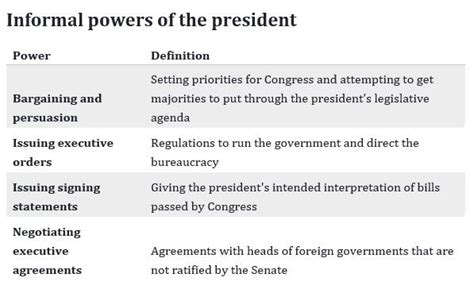
The President of the United States possesses not only the powers explicitly outlined in the Constitution but also a significant degree of informal power that allows them to influence the political landscape and governance decisions. This informal power extends beyond formal authority and grants the President the ability to shape policy and influence public opinion.
Types of Informal Power
The informal power of the President can be categorized into several types:
Persuasion:
The ability to influence others with charisma, communication skills, and public support.
Agenda-Setting:
The capacity to control the public discourse and prioritize issues for legislative and executive action.
Symbolism and Ritual:
The use of symbols, ceremonies, and tradition to evoke emotions and convey authority.
Lobbying and Negotiation:
Engaging with Congress, interest groups, and foreign leaders to build support and broker deals.
Sources of Informal Power
The sources of informal power include:
Public Support:
The President’s popularity, approval ratings, and perceived legitimacy bolster their ability to influence others.
Institutional Prestige:
The office of the Presidency carries inherent prestige and authority, which enables the President to command respect and attention.
Media Access:
The President’s direct access to the media allows them to communicate directly with the public and shape narratives.
Control over Resources:
The President’s ability to allocate resources, propose legislation, and veto bills gives them significant leverage in negotiations.
Examples of Informal Power in Action
Throughout history, Presidents have used their informal power to achieve significant outcomes:
- Franklin D. Roosevelt: Implemented the New Deal during the Great Depression through persuasion and skillful negotiation with Congress.
- Lyndon B. Johnson: Enacted the Civil Rights Act of 1964 through skillful lobbying and coalition-building.
- Ronald Reagan: Promoted conservative policies and reshaped the political landscape through effective communication and public support.
- Bill Clinton: Used his popularity and negotiation skills to pass the North American Free Trade Agreement (NAFTA).
Strategies to Enhance Informal Power
Presidents can enhance their informal power by employing effective strategies:
Building Relationships:
Establishing strong relationships with key individuals in government, business, and civil society.
Effective Communication:
Articulating a clear vision and effectively communicating it to the public and stakeholders.
Coalition-Building:
Forming alliances with groups, organizations, and individuals who support the President’s agenda.
Leveraging Technology:
Utilizing social media, the internet, and other technologies to connect with the public and mobilize support.
Consequences of Informal Power
The use of informal power can have both positive and negative consequences:
Pros:
- Increased effectiveness: Informal power allows the President to navigate political gridlock and implement their agenda more effectively.
- Public support: Informal power can enhance the President’s legitimacy and public support, leading to greater political capital.
Cons:
- Potential for abuse: Informal power can be used to bypass democratic institutions and undermine the separation of powers.
- Institutional erosion: Excessive reliance on informal power can weaken formal institutions and norms of governance.
Effective Strategies for Using Informal Power Responsibly:
- Transparency: Disclosing the use of informal power to ensure accountability.
- Checks and Balances: Seeking input from diverse perspectives and respecting the authority of other branches of government.
- Ethical Considerations: Exercising informal power within legal and ethical boundaries.
FAQs on the Informal Power of the President
1. What is the most significant source of informal power for the President?
Public support is the最も重要な情報源 of informal power for the President.
2. How can Presidents effectively leverage informal power?
Presidents can effectively leverage informal power through building relationships, effective communication, coalition-building, and leveraging technology.
3. What are the potential risks associated with the use of informal power?
The potential risks associated with the use of informal power include potential for abuse and institutional erosion.
4. How can Presidents ensure the responsible use of informal power?
Presidents can ensure the responsible use of informal power through transparency, checks and balances, and ethical considerations.
5. Can informal power be quantified?
While informal power cannot be directly quantified, its impact can be measured indirectly through indicators such as public opinion polls, legislative success rates, and presidential approval ratings.
6. What are the historical precedents for the use of informal power by Presidents?
Throughout history, Presidents such as Franklin D. Roosevelt, Lyndon B. Johnson, Ronald Reagan, and Bill Clinton have successfully used informal power to achieve significant outcomes.
7. Are there any legal or constitutional limits on the use of informal power?
While there are no explicit legal or constitutional limits on the use of informal power, the President is ultimately accountable to the public, Congress, and the courts for their actions.
8. Can informal power be used to undermine democratic institutions?
Excessive reliance on informal power can potentially undermine democratic institutions by circumventing established checks and balances and concentrating power in the executive branch.
Conclusion
The informal power of the President is a significant factor shaping American governance. By understanding the sources and types of informal power, Presidents can harness it to advance their agendas and influence policymaking. However, it is crucial to exercise this power responsibly within ethical and institutional boundaries to ensure the integrity of democratic institutions and the public trust.