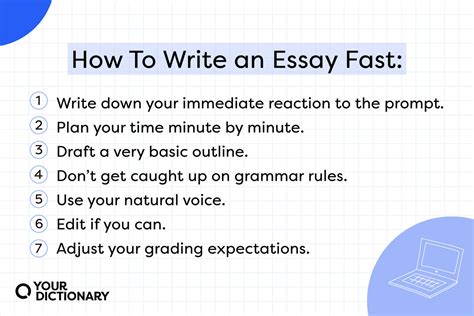
In today’s fast-paced academic environment, students are often faced with the daunting task of writing papers under tight deadlines. Writing a high-quality paper quickly can seem like an insurmountable challenge, but with the right strategies and techniques, it’s entirely possible. Here’s a comprehensive guide to help you write a paper fast without compromising quality.
Prewriting: Gather Your Thoughts
1. Brainstorm and Freewrite
Brainstorm ideas by jotting down everything that comes to mind related to your topic. Use a mind map, sticky notes, or any method that helps you generate ideas. Freewrite to connect your thoughts and develop a coherent outline.
2. Conduct Preliminary Research
Gather relevant sources from books, articles, and online databases. Read them quickly to understand the key arguments and supporting evidence.
3. Develop a Thesis Statement
Craft a clear and specific thesis statement that states your main argument and sets the direction for your paper.
Organization and Structure: Create a Blueprint
1. Outline Your Paper
Create an outline that includes an introduction, body paragraphs, and conclusion. Each body paragraph should address a different aspect of your argument and support your thesis.
2. Write the Introduction
- Begin with a hook to grab the reader’s attention.
- Provide background information on the topic.
- State your thesis statement clearly.
3. Write the Body Paragraphs
- Start each body paragraph with a topic sentence that supports your thesis.
- Provide evidence from your sources to support your claims.
- Use transitions to connect ideas and smooth the flow of your writing.
4. Write the Conclusion
- Restate your thesis statement in a slightly different way.
- Summarize the main arguments of your paper.
- Offer a final thought or call to action.
Writing Efficiently: Time Management and Focus
1. Use a Pomodoro Timer
Break down your writing task into intervals of focused work and short breaks. The Pomodoro Technique is a popular method that uses 25-minute work sessions followed by 5-minute breaks.
2. Avoid Distractions
Create a quiet and distraction-free workspace. Turn off notifications, close unnecessary browser tabs, and consider using noise-canceling headphones.
3. Set Realistic Goals
Don’t try to write the entire paper in one sitting. Set achievable goals for each writing session, such as completing a certain number of paragraphs or pages.
4. Take Breaks
Regular breaks are essential to maintain focus and prevent burnout. Get up and move around, grab a snack, or engage in a quick activity that helps you clear your mind.
Editing and Proofreading: Final Touches
1. Give Yourself Time
Allow some time between writing and editing to gain perspective on your work.
2. Check for Clarity and Conciseness
Read your paper aloud to identify any sentences or phrases that are unclear or repetitive. Aim for concise and impactful writing.
3. Proofread Carefully
Check for errors in grammar, spelling, and punctuation. Use spell-checking tools and read your paper several times before submitting it.
- Use a Writing App: Writing apps like Google Docs or Microsoft Word can offer features such as autocorrect, grammar checking, and collaboration tools.
- Create Templates: Develop templates for common paper formats (e.g., thesis statement, conclusion) to save time.
- Outsource Research: Consider using a research assistant or online service to gather sources and summarize key findings.
- Recycle Previous Work: If possible, reuse or adapt content from previous papers or assignments to save time.
- Collaborate: Work with classmates or peers to brainstorm ideas, research, and edit your paper.
1. Prewriting (15 minutes)
- Brainstorm and freewrite (5 minutes)
- Conduct preliminary research (5 minutes)
- Develop a thesis statement (5 minutes)
2. Organization and Structure (30 minutes)
- Outline your paper (10 minutes)
- Write the introduction (10 minutes)
- Write topic sentences for body paragraphs (10 minutes)
3. Writing Efficiently (60 minutes)
- Write body paragraphs (40 minutes)
- Use Pomodoro Technique or another time management method (20 minutes)
4. Editing and Proofreading (45 minutes)
- Set paper aside for 30 minutes
- Proofread for clarity and conciseness (15 minutes)
- Revise grammar, spelling, and punctuation (15 minutes)
1. How can I improve my writing speed?
- Practice writing regularly
- Use writing apps with time-saving features
- Minimize distractions
- Set achievable goals
2. What is the best way to stay focused while writing?
- Use a Pomodoro Timer
- Eliminate distractions
- Take breaks when needed
- Find a comfortable and quiet workspace
3. How can I avoid plagiarism?
- Cite all sources accurately
- Use quotation marks or block quotes to indicate direct quotations
- Paraphrase information in your own words
- Avoid excessive quoting
4. What are some common mistakes to avoid when writing a paper fast?
- Submitting a paper without proofreading
- Rushing through the writing process
- Not organizing thoughts and ideas before writing
- Overusing transitions or filler words
- Plagiarizing from other sources
Writing a paper fast doesn’t have to be an overwhelming task. By following the strategies and techniques outlined in this guide, you can produce a high-quality paper in a short amount of time. Remember to plan ahead, organize your thoughts, write efficiently, edit carefully, and seek support when needed. With practice and perseverance, you can master the art of fast and effective paper writing.