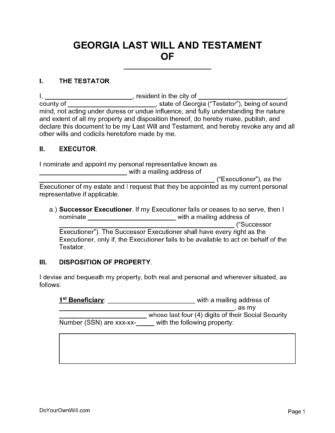
What is a Testament?

A testament, also known as a last will and testament, is a legal document that outlines your wishes for the distribution of your assets after your death. It allows you to control how your property is distributed, who will inherit your belongings, and who will be responsible for managing your estate.
Why Execute a Testament in Georgia?
Executing a testament in Georgia is an essential step in estate planning. It ensures that your wishes are respected and that your assets are distributed according to your intentions. Without a valid testament, the state of Georgia will distribute your property according to its intestacy laws, which may not align with your preferences.
Steps to Execute a Testament in Georgia
- Draft the Testament: You can either write your testament yourself using a template or hire an attorney to assist you.
- Choose an Executor: The executor is the person responsible for administering your estate after your death. They will ensure that your testament is carried out and that your assets are distributed according to your wishes.
- Sign the Testament: The testament must be signed in the presence of two witnesses who are at least 14 years old.
- Notarize the Testament: The witnesses must sign the testament in front of a notary public. The notary will verify the identity of the signer and witnesses and ensure that the testament is properly executed.
Requirements for a Valid Testament in Georgia
- Must be in writing
- Must be signed by the testator (signer)
- Must be witnessed by two witnesses
- Must be notarized
Common Mistakes to Avoid When Executing a Testament in Georgia
- Failing to sign the testament
- Failing to have the testament witnessed
- Failing to notarize the testament
- Using outdated or invalid forms
- Using language that is unclear or ambiguous
Benefits of Executing a Testament in Georgia
- Ensures that your wishes are respected
- Controls the distribution of your assets
- Appoints an executor to manage your estate
- Avoids costly probate proceedings
- Provides peace of mind for you and your loved ones
How to Execute a Testament if You Are Not a Georgia Resident
If you are not a resident of Georgia, you can still execute a testament in Georgia if you have property or other assets in the state. The testament must comply with the laws of Georgia and must be executed in accordance with the steps outlined above.
Table 1: Comparison of Probate and Non-Probate Assets
| Type of Asset | Probate | Non-Probate |
|---|---|---|
| Real estate | Yes | No |
| Bank accounts with a named beneficiary | No | Yes |
| Retirement accounts with a named beneficiary | No | Yes |
| Jointly owned property | No | Yes |
Table 2: Common Reasons for Contesting a Testament
| Reason | Percentage |
|---|---|
| Lack of capacity | 25% |
| Undue influence | 15% |
| Fraud | 10% |
| Duress | 5% |
| Mistake | 5% |
Table 3: Advantages and Disadvantages of Executing a Testament
| Advantage | Disadvantage |
|---|---|
| Controls the distribution of your assets | Can be contested |
| Appoints an executor to manage your estate | Can be expensive to draft and execute |
| Avoids costly probate proceedings | May require probate if there are disputes |
| Provides peace of mind for you and your loved ones | Can be time-consuming to create |
Table 4: Tips for Choosing an Executor
- Choose someone who is trustworthy and responsible
- Consider their financial management skills
- Ensure that they are willing to serve as executor
- Appoint a co-executor if you have a large estate or complex wishes