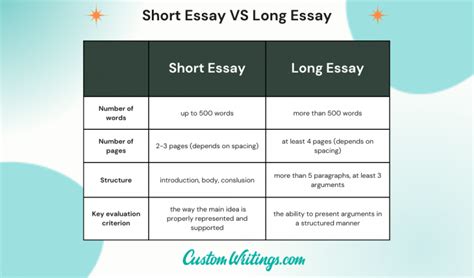
In the realm of academia, short essay answers play a pivotal role in assessing students’ understanding of complex concepts and their ability to articulate their thoughts concisely. While there is no universally accepted rule regarding the ideal length of short essay answers, there are certain guidelines and best practices that students can adhere to, depending on the specific requirements of the assignment.

Factors to Consider for Optimal Length
The optimal length of a short essay answer hinges on several key factors:
- Question Complexity: The length and complexity of the question itself influence the appropriate length of the answer. A simple question requiring a straightforward response may necessitate a shorter answer, while a complex question requiring in-depth analysis and multiple perspectives may warrant a longer answer.
- Assignment Instructions: Instructors typically provide specific instructions regarding the expected length of the answer. It is crucial to adhere to these guidelines to demonstrate compliance and avoid potential deductions for deviation.
- Time Constraints: In timed assessments, students are faced with the challenge of balancing the length of their answers with the time available. While it is generally advisable to provide a comprehensive response, it is equally important to manage time effectively to ensure that all questions are adequately addressed.
General Guidelines for Length
Based on these factors, the following general guidelines may serve as a starting point for determining appropriate lengths:
- Short Answer Questions (1-2 sentences): Typically used for factual recall or simple concepts, these questions require brief, concise answers.
- Medium Answer Questions (3-5 sentences): Allow students to provide a bit more detail and support their responses with evidence or examples.
- Extended Answer Questions (6+ sentences): Demand a comprehensive response that includes multiple perspectives, analysis, and synthesis of information.
Ideal Length for Common Essay Types
1. Short Answer Essays (SAEs):
- Generally limited to 100-200 words or approximately 3-6 sentences.
- Focus on providing a concise and focused response to a specific question.
2. Extended Essay Questions (EEQs):
- Typically range from 300-500 words or approximately 6-10 sentences.
- Require a more in-depth analysis and discussion of a topic, often incorporating multiple sources and perspectives.
Best Practices for Writing Lengthy Answers
1. Break Down the Question:
Analyze the question carefully to identify key concepts and the required level of detail. Determine the scope and depth of the answer necessary to address the question adequately.
2. Plan Your Structure:
Organize your thoughts and ideas into a coherent structure, such as an introduction, body paragraphs, and conclusion. This will help you stay focused and avoid rambling.
3. Provide Evidence and Examples:
Support your claims with relevant evidence, examples, and data. This will add credibility and depth to your answer.
4. Cite Your Sources:
When incorporating information from external sources, be sure to cite them accurately to avoid plagiarism and demonstrate academic integrity.
5. Proofread and Edit:
Once you have completed your answer, proofread it carefully for any errors in grammar, spelling, or punctuation. Make necessary revisions to ensure clarity and conciseness.
Tips and Tricks to Write Shorter Answers
1. Identify Key Points:
Focus on addressing the most important aspects of the question. Avoid unnecessary details or tangents that can lengthen your answer.
**2. Use Concis