
Understanding the Basics of GPA
Grade point average (GPA) is a numerical representation of a student’s academic performance over time. It serves as a standard measure for evaluating and comparing the academic achievements of students, particularly in secondary and higher education.
GPA is calculated based on a grading scale that assigns numerical values to letter grades. The most common grading scale in the United States is the 4.0 scale, where A equals 4.0, B equals 3.0, C equals 2.0, D equals 1.0, and F equals 0.0. Other grading scales, such as the 5.0 scale, are also used in some educational systems.
Calculating Your GPA
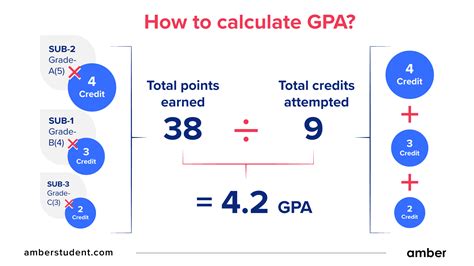
To calculate your GPA, you must weigh each of your grades by the number of credit hours earned for that course. For example, if you earn an A in a three-credit course, it contributes 4.0 x 3 = 12.0 quality points to your GPA.
Once you have calculated the quality points for each course, you need to divide the total number of quality points by the total number of credit hours attempted. This will give you your overall GPA.
GPA = Total Quality Points / Total Credit Hours Attempted
Importance of GPA
GPA is considered an important indicator of a student’s academic success and potential. It is used by colleges and universities for admissions decisions, scholarship awards, and academic honors. GPA can also be influential in job applications, as employers often use it as a measure of an applicant’s work ethic and intellect.
Strategies for Improving GPA
If you are looking to improve your GPA, there are several strategies you can employ:
- Attend class regularly and participate actively. This will help you understand the material better and earn higher grades on assignments and exams.
- Complete homework assignments on time and to the best of your ability. Homework is designed to reinforce what you learn in class and can help you avoid falling behind.
- Study effectively for exams. This involves creating a study schedule, reviewing your notes, and practicing problems.
- Seek help when needed. If you are struggling with a particular concept, don’t hesitate to ask your teacher or a tutor for assistance.
Don’t Make These Common Mistakes
There are a few common mistakes that students make when calculating or interpreting their GPA:
- Including courses that are not included in your GPA. Some courses, such as physical education or extracurricular activities, may not be counted towards your GPA.
- Assuming that your GPA will remain the same. Your GPA can fluctuate over time, depending on your performance in individual courses.
- Comparing your GPA to others. Everyone’s academic journey is different. Your GPA is a measure of your progress, not a comparison to others.
Conclusion
GPA is a valuable tool for assessing and communicating academic achievement. It is important to understand how it is calculated and how it can be used to support your educational goals. By following the tips and avoiding the mistakes outlined in this guide, you can maximize your GPA and improve your academic success.