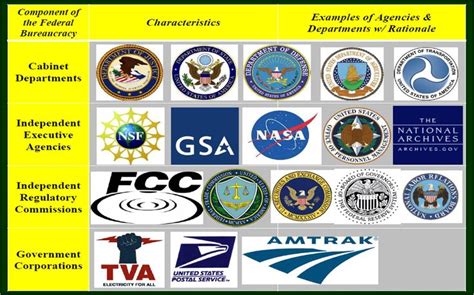
Government corporations are entities established by the government to carry out specific functions that are typically commercial in nature. They are separate from government agencies and departments and are typically organized as for-profit or not-for-profit corporations.

Key Characteristics of Government Corporations
- Created by the government: Government corporations are established by an act of the legislature or by executive order.
- Separate legal entities: Government corporations are separate legal entities from the government that created them. This means that they can sue and be sued, enter into contracts, and own property.
- Commercial activities: Government corporations typically engage in commercial activities, such as providing goods or services to the public. They may also be involved in research and development, or in providing financial assistance to businesses.
- Separate funding: Government corporations are typically funded through user fees, sales of goods or services, or borrowing. They may also receive some funding from the government.
Types of Government Corporations
There are two main types of government corporations:
- Government-owned, contractor-operated (GOCO): These corporations are owned by the government but are operated by private contractors. The government typically sets the policy for the corporation, while the contractor is responsible for the day-to-day operations.
- Government-owned, government-operated (GOGO): These corporations are owned and operated by the government. The government sets the policy for the corporation and is responsible for the day-to-day operations.
Examples of Government Corporations
Some common examples of government corporations include:
- United States Postal Service
- Federal Deposit Insurance Corporation (FDIC)
- Tennessee Valley Authority (TVA)
- Fannie Mae
- Freddie Mac
Advantages of Government Corporations
Government corporations offer a number of advantages over traditional government agencies and departments:
- Flexibility: Government corporations are more flexible than government agencies and departments, which allows them to respond more quickly to changing market conditions.
- Efficiency: Government corporations are typically more efficient than government agencies and departments, which can lead to lower costs and higher quality services.
- Innovation: Government corporations are more likely to innovate than government agencies and departments, which can lead to new products and services.
Disadvantages of Government Corporations
Government corporations also have some disadvantages:
- Accountability: Government corporations are less accountable to the public than government agencies and departments. This is because they are not subject to the same level of oversight.
- Competition: Government corporations can compete with private businesses, which can lead to unfair competition.
- Political influence: Government corporations can be influenced by political considerations, which can lead to decisions that are not in the best interests of the public.
Conclusion
Government corporations are a valuable tool for the government to use to carry out specific functions that are commercial in nature. They offer a number of advantages over traditional government agencies and departments, but they also have some disadvantages. It is important to weigh the advantages and disadvantages carefully when considering whether to create a government corporation.
Key Terms
- Government corporation
- GOCO
- GOGO
- User fees
- Borrowing
- Flexibility
- Efficiency
- Innovation
- Accountability
- Competition
- Political influence
Additional Information
- Government Corporations and Federal Procurement
- Government Corporations: A Primer
- Government Corporations: An Overview