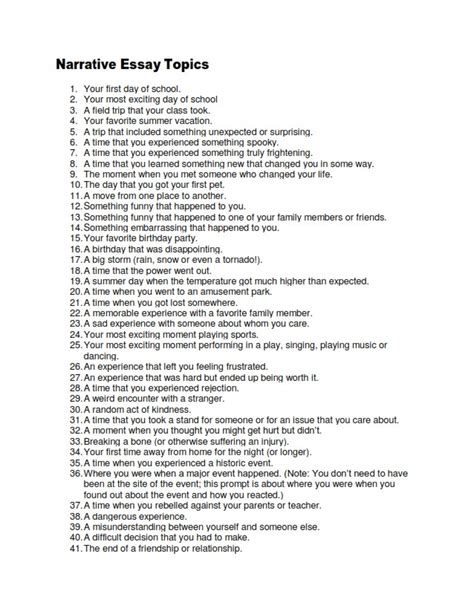
A narrative essay tells a story, usually based on a personal experience. The best narrative essays are well-written and engaging, and they leave the reader with a sense of having learned something or experienced something new.

Here are some tips for choosing a good narrative essay topic:
- Choose a topic that you are passionate about. This will make the writing process more enjoyable and will help you write a more convincing essay.
- Choose an experience that is meaningful to you. What does this experience say about you? What did you learn from it? How did it change you?
- Choose an experience that is unique. Your essay should stand out from the rest.
- Choose an experience that is appropriate for the audience. If you are writing for a general audience, avoid using too much jargon or technical language.
Once you have chosen a topic, you need to develop your essay. Here are some tips:
- Start with a strong hook. The first few sentences of your essay are crucial. They need to grab the reader’s attention and make them want to keep reading.
- Use vivid language. Paint a picture in the reader’s mind. Use sensory details to help the reader experience the story.
- Use a clear and concise style. Avoid using long sentences or complex vocabulary.
- Organize your essay logically. Use transitions to guide the reader from one idea to the next.
- Proofread your essay carefully before submitting it. Make sure there are no errors in grammar or spelling.
Types of Narrative Essays
There are many types of narrative essays, including:
- Personal narratives: These essays tell a story from the author’s own life.
- Fictional narratives: These essays tell a story that is made up.
- Historical narratives: These essays tell a story about a past event.
- Biographies: These essays tell the story of a person’s life.
- Travelogues: These essays tell the story of a journey.
Benefits of Writing Narrative Essays
There are many benefits to writing narrative essays, including:
- Improved writing skills: Narrative essays help you develop your writing skills in a variety of ways. You learn how to use language effectively, how to organize your thoughts, and how to tell a story.
- Increased creativity: Narrative essays allow you to express your creativity. You can use your imagination to create characters, settings, and events.
- Personal growth: Narrative essays can help you learn more about yourself. By reflecting on your experiences, you can gain a deeper understanding of your strengths, weaknesses, and values.
- Enhanced empathy: Narrative essays can help you develop empathy for others. By reading stories about the lives of others, you can gain a better understanding of their experiences and perspectives.
Here are some narrative essay ideas to get you started:
Personal Experiences
- A time when you overcame a challenge
- A time when you learned a valuable lesson
- A time when you made a difficult decision
- A time when you experienced a loss
- A time when you achieved a goal
- A time when you traveled to a new place
- A time when you met someone who changed your life
- A time when you had a life-changing experience
Fictional Stories
- A story about a love that was lost
- A story about a family that was torn apart
- A story about a person who overcame great odds
- A story about a person who made a sacrifice
- A story about a person who found redemption
- A story about a person who faced their fears
- A story about a person who found happiness
Historical Events
- The American Revolution
- The Civil War
- The Great Depression
- World War II
- The Vietnam War
- The 9/11 attacks
- The Great Recession
- The COVID-19 pandemic
Biographies
- Abraham Lincoln
- Martin Luther King, Jr.
- Rosa Parks
- Eleanor Roosevelt
- Jackie Robinson
- Malala Yousafzai
- Ruth Bader Ginsburg
Travelogues
- A trip to a foreign country
- A road trip across the United States
- A hike in the mountains
- A bike ride along the coast
- A cruise to the Caribbean
- A visit to a national park
- A weekend getaway to a nearby city
| Resource | Description |
|---|---|
| The Writer’s Digest | A website with articles, tips, and resources for writers |
| The Purdue Online Writing Lab | A free online writing center with resources on grammar, punctuation, and style |
| The National Council of Teachers of English | A professional organization for English teachers |
| The American Library Association | A professional organization for librarians |
| The College Board | A nonprofit organization that provides standardized tests and college admissions services |
- Brainstorm ideas: Before you start writing, brainstorm a list of potential topics. Once you have a list, you can narrow it down to the one that you are most passionate about.
- Outline your essay: Before you start writing, outline your essay. This will help you organize your thoughts and make sure that your essay flows smoothly.
- Write a rough draft: Don’t worry about writing a perfect first draft. Just get your thoughts down on paper. You can revise and edit your essay later.
- Get feedback from others: Once you have written a rough draft, ask for feedback from others. This could be a friend, family member, or teacher.
- Revise and edit your essay: Once you have received feedback, revise and edit your essay. Make sure that your essay is well-written, organized, and error-free.
- What is a narrative essay? A narrative essay tells a story, usually based on a personal experience.
- How do I choose a good narrative essay topic? Choose a topic that you are passionate about, that is meaningful to you, that is unique, and that is appropriate for the audience.
- How do I develop my narrative essay? Start with a strong hook, use