Introduction
The ratification of the United States Constitution in 1788 was a contentious process that pitted two distinct groups against each other: the Federalists and the Anti-Federalists. These groups held vastly different views on the new Constitution, its potential implications for the nation, and the role of the federal government.

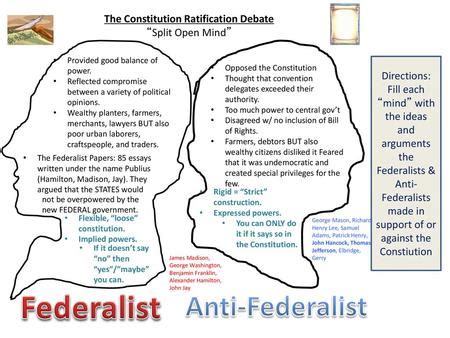
To understand the nature of these differences, we present a comprehensive chart that compares the key positions of the Federalists and Anti-Federalists. This chart will shed light on their ideologies, concerns, and the impact they had on the shaping of the Constitution and the American political system.
Federalist vs Anti-Federalist Chart
| Characteristic | Federalists | Anti-Federalists |
|---|---|---|
| Concept of Federalism | Strong central government with limited state powers | Decentralized power with strong state governments |
| Role of the Federal Government | Significant authority to regulate commerce, defense, and foreign policy | Limited role, primarily focused on national defense and international affairs |
| Federal Judicial Power | Favored a federal court system to interpret and enforce laws | Opposed a federal court system, arguing it would undermine state sovereignty |
| National Economy | Supported a strong national economy with tariffs and a national bank | Feared the development of a national economic monopoly |
| Individual Rights | Believed the Constitution protected individual rights | Demanded a Bill of Rights to safeguard individual liberties |
| Popular Sovereignty | Recognized the authority of the people to govern themselves | Emphasized the importance of state sovereignty and local control |
| Size of Government | Advocated for a larger and more powerful federal government | Preferred a smaller and less intrusive government |
| Ratification Process | Supported quick ratification with minimal amendments | Opposed ratification without significant changes and guarantees of state autonomy |
| Framers of the Constitution | James Madison, Alexander Hamilton, George Washington | Patrick Henry, Samuel Adams, George Mason |
| Key Supporters | Merchants, creditors, wealthy landowners | Farmers, frontiersmen, laborers |
Historical Context and Impact
The Federalists, led by figures such as Alexander Hamilton and James Madison, argued that a strong federal government was necessary to protect the nation from foreign threats, regulate commerce, and promote economic growth. They believed that the decentralized Articles of Confederation had failed to provide effective governance and that a centralized authority was essential for the young republic to thrive.
On the other hand, the Anti-Federalists, led by Patrick Henry and George Mason, opposed the proposed Constitution. They feared that a powerful federal government would erode state sovereignty and threaten individual liberties. They argued for a decentralized system of government with limited federal powers.
The debate between the Federalists and Anti-Federalists shaped the final form of the Constitution. The Anti-Federalists successfully secured the addition of the Bill of Rights, which guaranteed basic liberties and protected individual rights from encroachment by the federal government.
Legacy and Relevance
The debates between the Federalists and Anti-Federalists continue to resonate in American political discourse today. The ongoing debates about the proper balance between federal and state power, the role of the federal government in regulating the economy, and the protection of individual rights are rooted in the ideological divide that emerged during the founding era.
Tips and Tricks
- Understand the historical context: The Federalist and Anti-Federalist debate occurred in the aftermath of the Revolutionary War, when the nation was grappling with the need for a new governing document.
- Compare motivations: The Federalists sought to create a strong federal government, while the Anti-Federalists prioritized state sovereignty and individual liberty.
- Analyze their arguments: The Federalists argued for efficiency and security, while the Anti-Federalists emphasized local control and the protection of rights.
- Consider the outcomes: The debate resulted in a Constitution that balanced federal power with individual rights and preserved the role of both federal and state governments.
FAQs
1. What was the main difference between Federalists and Anti-Federalists?
The main difference was their view on the role of the federal government. Federalists wanted a strong central government, while Anti-Federalists preferred a decentralized system with strong state powers.
2. What is federalism?
Federalism is a system of government in which power is divided between a central government and複数の smaller governments, such as states or provinces.
3. What were the key concerns of the Anti-Federalists?
Anti-Federalists feared that a powerful federal government would threaten individual rights, erode state sovereignty, and create a national economic monopoly.
4. What were the key arguments of the Federalists?
Federalists argued that a strong federal government was necessary for national security, economic prosperity, and efficient governance.
5. How did the debate between Federalists and Anti-Federalists impact the Constitution?
The debate led to the inclusion of the Bill of Rights, which guaranteed individual liberties and protected state autonomy.
6. What is the legacy of the Federalist and Anti-Federalist debate?
The debate continues to shape American political discourse today, influencing discussions about federal power, states’ rights, and the protection of individual rights.