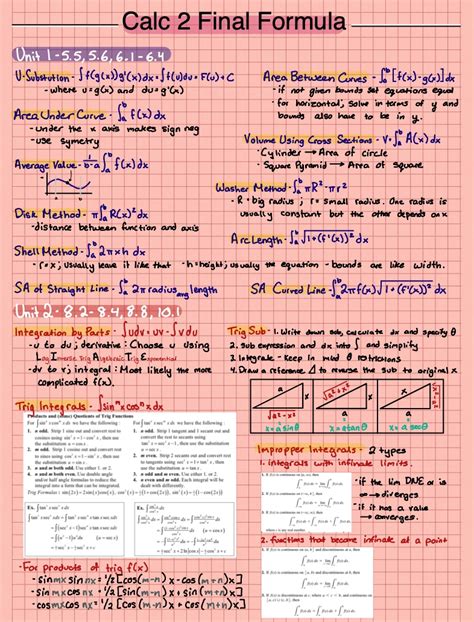
Calculus 2, also known as multivariable calculus, extends the concepts of single-variable calculus to functions of two or more variables. Understanding these formulas is crucial for mastering this essential branch of mathematics.
Table of Essential Calc 2 Formulas
| Concept | Formula |
|---|---|
| Partial Derivative (1st Order) | ( \frac{\partial z}{\partial x} ) |
| Partial Derivative (2nd Order) | ( \frac{\partial^2 z}{\partial x \partial y} ) |
| Directional Derivative | ( \nabla f(x, y) \cdot \mathbf{u} ) |
| Gradient | ( \nabla f(x, y) = \left( \frac{\partial f}{\partial x}, \frac{\partial f}{\partial y} \right) ) |
| Divergence | ( \nabla \cdot \mathbf{F} = \frac{\partial P}{\partial x} + \frac{\partial Q}{\partial y} ) |
| Curl | ( \nabla \times \mathbf{F} = \left( \frac{\partial Q}{\partial x} – \frac{\partial P}{\partial y}, \frac{\partial P}{\partial z} – \frac{\partial R}{\partial x}, \frac{\partial R}{\partial y} – \frac{\partial Q}{\partial z} \right) ) |
| Line Integral | ( \int_C f(x, y) ds ) |
| Surface Integral | ( \iint_S f(x, y, z) dS ) |
| Green’s Theorem | ( \oint_C P dx + Q dy = \iint_R \left( \frac{\partial Q}{\partial x} – \frac{\partial P}{\partial y} \right) dA ) |
| Stokes’ Theorem | ( \oint_C \mathbf{F} \cdot d\mathbf{r} = \iint_S (\nabla \times \mathbf{F}) \cdot \mathbf{n} dS ) |
Applications of Calc 2 Formulas
Engineering and Physics:
- Modeling fluid flow, heat transfer, and electromagnetic fields
- Designing structures, machines, and vehicles
- Optimizing energy consumption
Data Science and Artificial Intelligence:
- Analyzing multivariate datasets
- Training machine learning models
- Optimizing algorithms
Economics and Finance:
- Forecasting demand, supply, and prices
- Managing investment portfolios
- Allocating resources
Innovations with Calc 2 Formulas
Personalized Medicine: By incorporating patient-specific data, calc 2 formulas can revolutionize medical diagnosis and treatment.
Overcoming Common Mistakes
- Misapplying formulas: Ensure you understand the assumptions and limitations of each formula.
- Ignoring boundary conditions: Consider the specific problem and apply the appropriate boundary conditions.
- Neglecting continuity and differentiability: Check if the function and its derivatives are continuous and differentiable, as required by the formulas.
Conclusion
Mastering Calc 2 formulas unlocks the door to a wide range of applications. From engineering to data science and beyond, these formulas provide the foundation for solving complex problems and driving innovation. By understanding and using them effectively, you empower yourself to tackle real-world challenges and make meaningful contributions.