Introduction
Piecewise functions are a versatile tool in mathematics, allowing us to represent complex functions that are defined differently over different intervals. Derivatives are fundamental in calculus, providing the rate of change of a function. In this article, we delve into how to find the derivative of piecewise functions, exploring practical applications and common pitfalls.
The Definition of a Piecewise Function
A piecewise function is defined as a function that is composed of multiple subfunctions, each of which is defined over a specific interval. The overall function is determined by the value of the subfunction within the corresponding interval.
For example, a piecewise function that represents the cost of shipping a package based on its weight can be defined as follows:
f(x) =
-
5ifx ≤ 1 -
8if1 < x ≤ 3 -
12ifx > 3
Finding the Derivative of a Piecewise Function
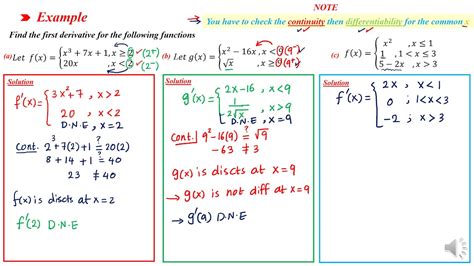
The derivative of a piecewise function is found by calculating the derivative of each subfunction within its corresponding interval. The derivative is defined as the slope of the function at a given point, which represents the instantaneous rate of change.
For the above example, the derivatives of the subfunctions are:
-
f'(x) = 0ifx ≤ 1 -
f'(x) = 0if1 < x ≤ 3 -
f'(x) = 0ifx > 3
Applications of Piecewise Derivatives
Piecewise derivatives have numerous applications in various fields, including:
- Engineering: Modeling the behavior of complex systems with piecewise linear or exponential functions
- Economics: Analyzing market demand and supply, which can exhibit piecewise behavior
- Medicine: Evaluating the changing concentrations of drugs or hormones over time, which can follow piecewise exponential decay
- Computer Science: Designing piecewise linear functions to approximate complex algorithms
Common Mistakes to Avoid
When working with piecewise derivatives, there are several common mistakes to avoid:
- Not checking for continuity: Ensure that the function is continuous at the boundaries between subfunctions.
- Forgetting to use the chain rule: Apply the chain rule when dealing with nested piecewise functions.
-
Substituting incorrect values: Use the appropriate subfunction when evaluating the derivative for a given
x.
Tips and Tricks
- Use a table of values: Create a table with the subfunctions, intervals, and their corresponding derivatives.
- Plot the function: Visualize the piecewise function and its derivative to gain insights into its behavior.
- Consider the piecewise nature: Remember that the derivative will change abruptly at the boundaries between subfunctions.
Creative Applications
By exploring the concept of piecewise derivatives, we can generate innovative ideas for new applications:
- Piecewise neural networks: Develop neural networks that utilize piecewise functions as activation functions to improve model adaptability.
- Adaptive control systems: Design control systems that adjust their parameters based on the piecewise behavior of the measured signal.
- Image enhancement: Apply piecewise image processing techniques to enhance image quality by preserving edges and smoothing regions.
Tables
| Subfunction | Interval | Derivative |
|---|---|---|
| f(x) = x^2 | x ≤ 2 | f'(x) = 2x |
| f(x) = x + 1 | x > 2 | f'(x) = 1 |
| Piecewise Function | Domain | Range |
|---|---|---|
| f(x) = | R | [-∞, ∞] |
| Application | Field | Description |
|---|---|---|
| Piecewise exponential decay | Medicine | Modeling the decrease in drug concentration over time |
| Piecewise linear approximation | Engineering | Approximating a nonlinear function with linear segments |
| Piecewise constant rate | Economics | Representing supply or demand curves with different slopes in different market conditions |
| Tip | Benefit |
|---|---|
| Use substitution | Simplifies complex expressions |
| Check for continuity | Ensures validity of the derivative |
| Plot the graph | Visualizes behavior and avoids mistakes |