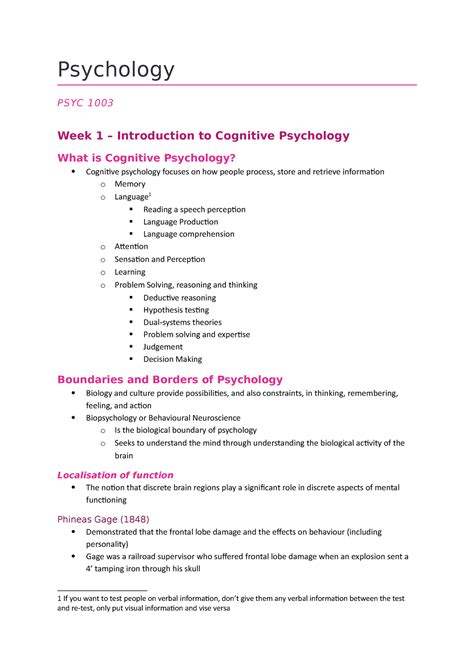
Chapter 1: Introduction to Psychology
- Psychology is the scientific study of behavior and mental processes.
- Psychologists use a variety of methods to study psychology, including observation, experimentation, and interviews.
- Psychology is a diverse field with many different subfields, including cognitive psychology, developmental psychology, and social psychology.
Chapter 2: Biological Bases of Behavior
- The brain is the organ that controls behavior and mental processes.
- The brain is divided into two hemispheres, the left and right hemispheres.
- The left hemisphere is responsible for language, logic, and analytical thinking.
- The right hemisphere is responsible for creativity, emotions, and spatial reasoning.
Chapter 3: Sensation and Perception
- Sensation is the process of detecting physical stimuli from the environment.
- Perception is the process of interpreting sensory information.
- Sensation and perception are influenced by a variety of factors, including culture, experience, and expectations.
Chapter 4: Learning
- Learning is the process of acquiring new knowledge and skills.
- There are many different types of learning, including classical conditioning, operant conditioning, and social learning.
- Learning is influenced by a variety of factors, including motivation, rewards, and punishments.
Chapter 5: Memory
- Memory is the process of storing and retrieving information.
- There are two main types of memory, short-term memory and long-term memory.
- Short-term memory stores information for a short period of time, while long-term memory stores information for a long period of time.
Chapter 6: Thinking and Language
- Thinking is the process of using information to solve problems and make decisions.
- Language is a system of symbols that is used to communicate ideas.
- Thinking and language are closely related, and they both rely on the brain.
Chapter 7: Motivation and Emotion
- Motivation is the process that drives behavior.
- Emotion is a subjective experience that is often associated with motivation.
- Motivation and emotion are both influenced by a variety of factors, including culture, experience, and genetics.
Chapter 8: Development
- Development is the process of change that occurs over time.
- Development occurs in a variety of areas, including physical development, cognitive development, and social development.
- Development is influenced by a variety of factors, including genetics, environment, and experiences.
Chapter 9: Personality
- Personality is the unique set of characteristics that define an individual.
- Personality is influenced by a variety of factors, including genetics, environment, and experiences.
- Personality is relatively stable over time, but it can change in response to major life events.