Introduction
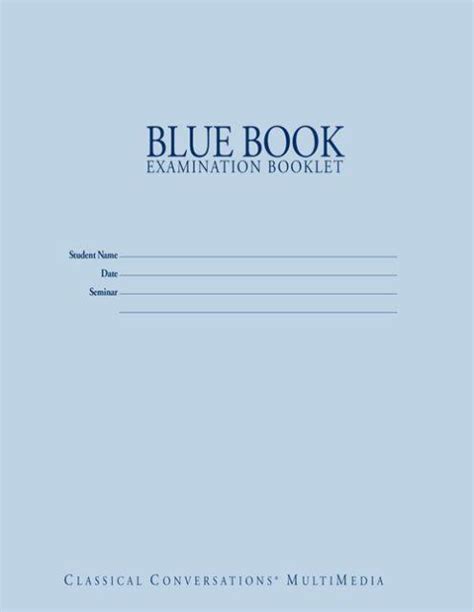
The blue book examination booklet is an integral component of higher education, serving as the canvas upon which students showcase their academic prowess. Understanding its nuances and effectively navigating its challenges can dramatically enhance academic performance. This comprehensive guide will delve into the intricacies of the blue book, empowering you with strategies and insights to maximize your exam success.
Anatomy of the Blue Book Examination Booklet
Typically, a blue book comprises a set of lined pages bound together in a lightweight paper or cardboard cover. The pages are numbered sequentially, providing a structured platform for answering questions and organizing responses. Some blue books may feature blank or perforated sections for rough work or additional notes.
Best Practices for Blue Book Examination
1. Preparation:
Before embarking on the exam, allocate ample time to review the exam instructions thoroughly. Ensure you comprehend the question formats, time constraints, and any specific requirements for citations or references.
2. Time Management:
Plan your time wisely. Divide the available time among the questions, allocating more time to those carrying higher weightage. Prioritize answering questions you are confident about first, then tackle the more challenging ones.
3. Organization:
Structure your answers clearly and logically. Use headings, subheadings, and bullet points to enhance readability. Begin each answer on a new page, leaving ample white space around your text.
4. Content:
Provide thorough and well-supported responses. Cite evidence from the course materials, textbooks, or personal research. Use specific examples and explanations to demonstrate your understanding.
5. Presentation:
Maintain a neat and legible handwriting. Avoid excessive cross-outs or erasures. If necessary, use extra pages as needed, but clearly indicate the continuation of your answer.
6. Proofreading:
After completing the exam, allocate time to proofread your answers carefully. Check for any errors in grammar, spelling, or content. Minor mistakes can detract from the quality of your responses.
7. Essay Questions:
a. Introduction: Begin with a clear thesis statement that encapsulates your main argument.
b. Body Paragraphs: Structure each paragraph around a specific supporting point. Develop your points with evidence, examples, and analysis.
c. Conclusion: Summarize the main points of your essay and restate your thesis in a slightly different way.
8. Multiple Choice Questions:
a. Elimination Technique: Rule out obviously incorrect answers first.
b. Process of Elimination: Eliminate answers that do not match the question or contain conflicting information.
Benefits of Blue Book Examinations
- Structured Assessment: Blue book exams provide a standardized format that ensures equitable evaluation of student knowledge and skills.
- Time Management Skills: Students learn to manage their time effectively and prioritize their efforts.
- Critical Thinking: Exams stimulate critical thinking and problem-solving abilities.
- Written Communication Skills: Blue books foster written communication skills, enhancing students’ ability to express their ideas clearly and coherently.
- Objective Assessment: Multiple-choice questions offer objective assessment, reducing the potential for bias or subjective interpretation.
Pros and Cons of Blue Book Examinations
Pros:
- Versatile: Blue books can accommodate various question formats, including essays, multiple choice, short answer, and problem-solving.
- Cost-Effective: Blue books are relatively inexpensive to produce, making them a cost-effective assessment tool.
- Widely Used: The familiarity of blue books ensures a consistent standard across exam settings.
Cons:
- Limited Space: Blue books can be space-restrictive, especially for lengthy essay responses.
- Time-Consuming: For longer exams, writing on blue books can be physically and mentally demanding.
- Prone to Errors: Handwritten responses may contain errors, making it challenging for instructors to grade accurately.
Alternative Examination Formats
While blue books remain prevalent, alternative examination formats are gaining popularity. These include:
- Computer-Based Testing (CBT): Exams delivered through computers offer automated scoring and immediate feedback.
- Online Exams: Exams conducted through online platforms provide flexibility and convenience.
- Oral Exams: Exams involving verbal presentations or discussions allow students to demonstrate their knowledge and communication skills.
Innovation: The “Exanoplast”** Approach
Inspired by the versatility and adaptability of blue books, we propose the concept of the “exanoplast” – an enhanced examination booklet that seamlessly integrates digital and physical elements.
Features of the Exanoplast:
- Digital Note-Taking: Integrated stylus or touch screen functionality enables digital note-taking and annotations.
- Multiple Page Views: Students can view multiple pages simultaneously, facilitating comparisons and cross-referencing.
- Automatic Grading: Built-in software analyzes and grades multiple-choice questions, providing instant feedback.
- Customization: Exanoplasts can be customized to specific exam requirements, such as incorporating images, diagrams, or interactive simulations.
Benefits of the Exanoplast:
- Enhanced Efficiency: Digital features streamline note-taking and grading processes, saving time and reducing errors.
- Greater Flexibility: The ability to view multiple pages and customize the exam format enhances the student experience.
- Personalized Feedback: Automatic grading provides immediate feedback, allowing students to identify areas for improvement.
- Adaptive Learning: Integrated analytics can track student progress and adapt the exam difficulty accordingly.
Conclusion
The blue book examination booklet has served as an enduring cornerstone of higher education. By understanding its intricacies and employing effective strategies, students can maximize their academic performance. However, the emergence of alternative formats and innovative concepts like the “exanoplast” offers promising avenues for enhancing the examination experience and fostering student success.