In the realm of statistics, sampling techniques hold immense significance. They allow us to make inferences about a large population by examining only a smaller subset—a methodology commonly employed in various fields such as market research, quality control, and public opinion polls. In AP Statistics Unit 4 Chapter 6, students delve into the intricacies of sampling, mastering the principles and applications of this fundamental statistical tool. The Free Response Questions (FRQ) within this chapter present challenging scenarios that test students’ understanding of sampling techniques and their ability to apply these concepts in real-world contexts.
Types of Sampling Techniques
One of the key concepts students encounter in Chapter 6 is the distinction between different types of sampling techniques. The three primary types are:
- Simple Random Sampling: Each member of the population has an equal chance of being selected.
- Systematic Random Sampling: Members of the population are selected at regular intervals, such as every 10th or 100th person.
- Stratified Random Sampling: The population is divided into subgroups (strata) based on shared characteristics, and then members are randomly selected from each stratum.
Students must be able to identify the appropriate sampling technique for different situations, considering factors such as the population size, the availability of sampling frames, and the desired level of accuracy.
Calculating Confidence Intervals
Another crucial aspect of sampling is the ability to calculate confidence intervals for population parameters. Confidence intervals provide a range of values within which the true population parameter is likely to fall. The formula for calculating a confidence interval is:
Sample Statistic ± Margin of Error
The margin of error is determined by the sample size, the level of confidence, and the standard deviation of the population. Students must be able to apply this formula to calculate confidence intervals for both means and proportions.
Hypothesis Testing
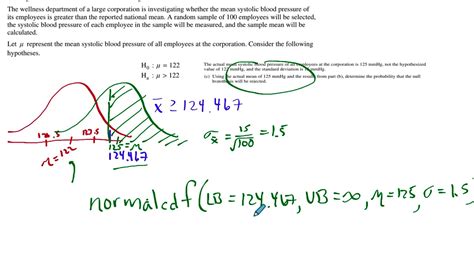
Hypothesis testing is a statistical procedure used to determine whether there is sufficient evidence to reject a null hypothesis. In Chapter 6, students learn how to conduct hypothesis tests using samples and calculate p-values. A p-value represents the probability of obtaining a sample statistic as extreme as or more extreme than the one observed, assuming the null hypothesis is true. If the p-value is less than the level of significance (usually 0.05), the null hypothesis is rejected.
Applications of Sampling
Sampling techniques have a wide range of applications across various disciplines. Some notable examples include:
| Application | Description |
|---|---|
| Market Research: Surveying a sample of consumers to gather insights about product preferences and purchasing habits. | |
| Quality Control: Selecting a sample of products to inspect for defects and estimate the overall quality level. | |
| Public Opinion Polls: Interviewing a sample of voters to gauge their preferences for political candidates or policies. | |
| Medical Research: Conducting clinical trials on a sample of patients to evaluate the effectiveness of new treatments or drugs. |
Tips for Tackling FRQs
Mastering AP Statistics Unit 4 Chapter 6 FRQs requires a combination of conceptual understanding, problem-solving skills, and effective communication. Here are some tips for tackling these questions successfully:
- Identify the Type of Sampling: Determine which sampling technique was used and explain its advantages and disadvantages.
- Calculate Confidence Intervals: Use the appropriate formula to calculate confidence intervals for the population parameters of interest.
- Conduct Hypothesis Tests: State the null and alternative hypotheses, calculate the p-value, and draw a conclusion.
- Interpret Results: Explain the meaning of the confidence intervals and hypothesis test results in terms of the research question.
- Write Clearly and Concisely: Write your responses in a clear and organized manner, using correct statistical terminology and providing logical reasoning.
Conclusion
AP Statistics Unit 4 Chapter 6 FRQs provide students with an opportunity to demonstrate their mastery of sampling techniques. By understanding the different types of sampling, calculating confidence intervals, conducting hypothesis tests, and recognizing the practical applications of sampling, students will develop the foundational skills necessary for success in statistics and beyond.