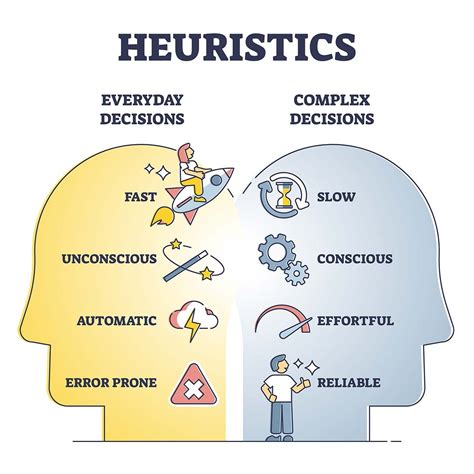
In the realm of cognitive psychology, heuristics are mental shortcuts that simplify decision-making by using readily available information. These shortcuts offer a practical path to finding solutions and judgments, particularly when time or resources are limited. Understanding heuristics is paramount for comprehending human cognitive processes and decision-making patterns.

Characteristics of Heuristics
Heuristics offer several distinct advantages:
- Efficiency: They minimize cognitive effort and save time.
- Simplicity: They rely on easily accessible information.
- Speed: They facilitate rapid decision-making.
However, they also have limitations:
- Accuracy: Heuristics may not always lead to the optimal solution.
- Bias: They can introduce biases and distortions into judgments.
Types of Heuristics
Psychologists have identified numerous types of heuristics, each serving a specific purpose. Common examples include:
- Availability Heuristic: Judging the likelihood of an event based on how easily examples of it come to mind.
- Representativeness Heuristic: Assessing the likelihood of an event by comparing it to a prototype or stereotype.
- Anchoring Heuristic: Using an initial piece of information as a reference point for subsequent judgments.
- Confirmation Bias: Seeking information that confirms existing beliefs while ignoring contradictory evidence.
Applications of Heuristics
Heuristics play a vital role in various aspects of life, including:
Cognitive Load: When cognitive resources are limited, heuristics help us make decisions without overloading our brains.
Complex Situations: In complex environments, heuristics provide a simplified framework for evaluating options.
Everyday Judgments: Heuristics guide our judgments in everyday tasks, such as estimating distances or assessing risk.
Novel Applications: “Heuristics Engineering”
To harness the power of heuristics beyond traditional applications, we introduce the concept of “heuristics engineering.” This approach involves:
- Identifying situations where heuristics can enhance decision-making.
- Developing new heuristics tailored to specific domains.
- Evaluating the effectiveness of heuristics and refining them as needed.
Example: Creating heuristics to optimize investment strategies or streamline medical diagnoses.
Benefits of Using Heuristics
Incorporating heuristics into decision-making offers numerous benefits:
- Reduced Cognitive Burden: Conserves mental energy and reduces stress.
- Enhanced Efficiency: Accelerates decision-making and improves productivity.
- Improved Judgment: Provides a structured approach to evaluating information.
- Increased Confidence: Facilitates decision-making based on available knowledge.
- Better Problem-Solving: Allows for creative solutions and identifies potential pitfalls.
Common Mistakes to Avoid
While heuristics can be valuable tools, certain mistakes should be avoided:
- Overreliance: Using heuristics excessively can lead to biased judgments.
- Blind Acceptance: Assuming heuristics are always accurate.
- Neglecting Other Information: Dismissing other relevant information in favor of heuristics.
Why Heuristics Matter
Understanding heuristics is crucial for several reasons:
- Cognitive Insights: Provides insights into how humans make decisions and solve problems.
- Informed Decision-Making: Enhances decision-making by identifying potential biases and limitations.
- Bias Mitigation: Helps identify and mitigate cognitive biases.
- Enhanced Learning: Aids in understanding how people acquire and use knowledge.
Conclusion
In the intricate tapestry of human cognition, heuristics serve as essential tools that simplify decision-making. While they offer numerous advantages, it is important to use them judiciously and with an awareness of their potential limitations. Through a deeper understanding of heuristics and the application of heuristics engineering, we can harness their power to enhance our cognitive abilities, improve decision-making, and unlock new frontiers of problem-solving.
Tables
| Table 1: Types of Heuristics |
|—|—|
| Name | Description |
| Availability Heuristic | Judging the likelihood of an event based on how easily examples of it come to mind. |
| Representativeness Heuristic | Assessing the likelihood of an event by comparing it to a prototype or stereotype. |
| Anchoring Heuristic | Using an initial piece of information as a reference point for subsequent judgments. |
| Confirmation Bias | Seeking information that confirms existing beliefs while ignoring contradictory evidence. |
| Table 2: Applications of Heuristics |
|—|—|
| Domain | Application |
| Psychology | Assessing personality traits, predicting behavior |
| Medicine | Diagnosing diseases, prescribing treatments |
| Economics | Making investment decisions, forecasting economic trends |
| Marketing | Understanding consumer behavior, designing marketing campaigns |
| Table 3: Benefits of Using Heuristics |
|—|—|
| Benefit | Explanation |
| Reduced Cognitive Burden | Conserves mental energy and reduces stress. |
| Enhanced Efficiency | Accelerates decision-making and improves productivity. |
| Improved Judgment | Provides a structured approach to evaluating information. |
| Increased Confidence | Facilitates decision-making based on available knowledge. |
| Better Problem-Solving | Allows for creative solutions and identifies potential pitfalls. |
| Table 4: Common Mistakes to Avoid When Using Heuristics |
|—|—|
| Mistake | Explanation |
| Overreliance | Using heuristics excessively can lead to biased judgments. |
| Blind Acceptance | Assuming heuristics are always accurate. |
| Neglecting Other Information | Dismissing other relevant information in favor of heuristics. |