Introduction
Advanced Placement Government and Politics is a rigorous course that delves into the complexities of American politics. These notes provide a comprehensive overview of the course material, covering key concepts, essential facts, and analysis techniques. Students preparing for the AP Gov exam will find this guide invaluable for reviewing and reinforcing their knowledge.
Structure of American Government
Federalism
- Definition: A system where power is divided between a central government and regional governments.
- Levels of Government: Federal, state, and local.
- Division of Powers: The Constitution assigns specific powers to each level of government to prevent tyranny.
Checks and Balances
- Definition: A system designed to prevent any one branch of government from becoming too powerful.
- Key Players: Executive, legislative, and judicial branches.
- Mechanisms: Veto power, judicial review, impeachment.
Separation of Powers
- Definition: The division of government functions among distinct branches to avoid concentrated authority.
- Executive Branch: President and executive agencies.
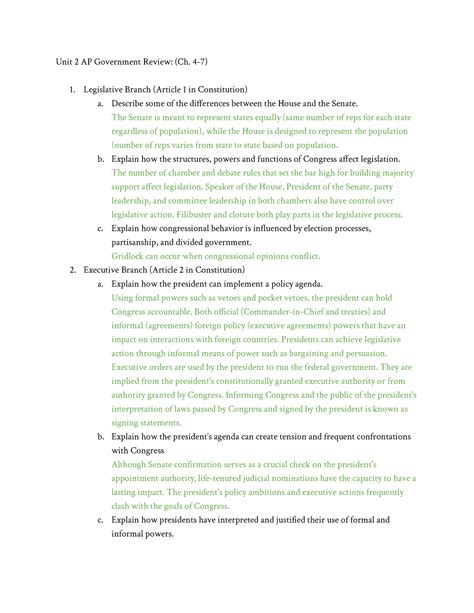
- Legislative Branch: Congress, consisting of the Senate and House of Representatives.
- Judicial Branch: Courts, including the Supreme Court.
The Constitution
Historical Background
- Ratification in 1788.
- Replaced the Articles of Confederation due to its weaknesses (e.g., lack of central government).
- Enshrined the principles of limited government and individual rights.
Key Principles
- Popular Sovereignty: Government derives its authority from the people.
- Limited Government: Government powers are restricted by the Constitution to protect individual liberties.
- Due Process: Individuals must be treated fairly by the government.
- Equal Protection: The government must treat all citizens equally under the law.
Congress
Composition
- Bicameral Legislature: Senate (100 members) and House of Representatives (435 members).
- Term Limits: Senators serve 6-year terms; Representatives serve 2-year terms.
Powers
- Legislative Power: Makes laws, declares war, raises taxes.
- Oversight Power: Investigates the executive branch and monitors federal programs.
- Impeachment Power: Can remove the President or other high-level officials from office.
The Presidency
Role
- Chief Executive: Head of the executive branch and enforces laws.
- Commander-in-Chief: Leads the armed forces.
- Chief Diplomat: Manages foreign policy.
Powers
- Veto Power: Can reject legislation passed by Congress.
- Executive Orders: Directives that have the force of law.
- Appointment Power: Nominates key officials, including judges and cabinet members.
The Judiciary
Structure
- Supreme Court: Highest court in the land.
- Federal Courts: Lower courts with specific jurisdictions.
Functions
- Judicial Review: Can declare laws unconstitutional.
- Interpretation of Laws: Determines the meaning and application of laws.
- Settling Disputes: Resolves legal controversies between parties.
Political Culture and Participation
Political Culture
- Refers to the shared beliefs, values, and attitudes that shape how people view their government and politics.
- American Political Culture: Individualism, liberty, equality, democracy.
Political Participation
- Voting: The primary means of citizen participation in government.
- Interest Groups: Organizations that represent specific interests and lobby for policy changes.
- Political Parties: Organizations that organize candidates for office and mobilize voters.
Public Policy
Definition
- Government decisions and actions that address societal issues.
Policy-Making Process
- Agenda Setting: Identifying and prioritizing issues.
- Formulation: Developing policies to address the issues.
- Implementation: Putting policies into action.
- Evaluation: Assessing the effectiveness of policies.
Civil Liberties
Definition
- Fundamental rights and freedoms protected by the Constitution.
Key Civil Liberties
- Freedom of Speech: The right to express one’s opinions and ideas.
- Freedom of Religion: The right to practice one’s religion without government interference.
- Due Process of Law: The right to fair and impartial legal treatment.
- Equal Protection under the Law: The right to be treated equally by the government, regardless of race, gender, or other factors.
Civil Rights
Definition
- The legal rights and protections that ensure equality of opportunity for all citizens.
Key Civil Rights
- Voting Rights Act: Prohibits discrimination in voting.
- Civil Rights Act of 1964: Prohibits discrimination based on race, color, religion, sex, or national origin.
- Affirmative Action: Policies aimed at increasing opportunities for underrepresented groups.
Comparative Government
Comparative Politics
- Study of different political systems around the world.
Types of Government
- Democracy: Government by the people, where citizens participate in decision-making.
- Autocracy: Government by one person or a small group, with limited citizen participation.
- Totalitarianism: Government that controls all aspects of public and private life.
Foreign Policy
Definition
- The policies and actions that a country takes in relation to other countries.
Key Components
- Diplomacy: Negotiation and dialogue with other nations.
- Military Power: Use of armed forces to protect national interests.
- Economic Statecraft: Use of economic tools (e.g., sanctions, trade) to influence other countries.
Tables
| Feature | Benefits |
|---|---|
| Federalism | Prevents tyranny, allows for local decision-making |
| Checks and Balances | Ensures no one branch becomes too powerful |
| Separation of Powers | Distributes powers to avoid concentrated authority |
| Judicial Review | Protects individual rights by limiting government action |
| Term | Definition |
|---|---|
| Electoral College | System used to elect the President, where each state receives a number of electors based on population |
| Gerrymandering | Drawing electoral districts to give one party an advantage |
| Lobbying | Attempting to influence government decisions by interest groups |
| Filibuster | Tactic in the Senate to delay or prevent votes |
| Type of Government | Key Characteristics |
|---|---|
| Democracy | Citizen participation, free elections, rule of law |
| Autocracy | One-person or small group rule, limited citizen participation |
| Totalitarianism | Government control over all aspects of life |
| Foreign Policy Tool | Uses |
|---|---|
| Diplomacy | Negotiation, dialogue |
| Military Power | Protecting national interests, deterring threats |
| Economic Statecraft | Influencing other countries through economic means |
FAQs
-
What is the most important principle of the Constitution?
– Popular Sovereignty: Government derives its authority from the people. -
What is the role of the President?
– Chief Executive, Commander-in-Chief, Chief Diplomat. -
What is the purpose of the Supreme Court?
– To interpret the Constitution and ensure that laws are constitutional. -
What are the key differences between a democracy and an autocracy?
– Citizen participation, free elections, rule of law (democracy); one-person or small group rule, limited citizen participation (autocracy). -
What is the importance of foreign policy?
– Protect national interests, promote international cooperation, respond to global challenges. -
What are the main civil liberties protected by the Constitution?
– Freedom of speech, religion, due process, equal protection. -
What is the purpose of affirmative action?
– Increase opportunities for underrepresented groups. -
How does lobbying influence government decision-making?
– By providing information, shaping public opinion, and influencing lawmakers.