Introduction
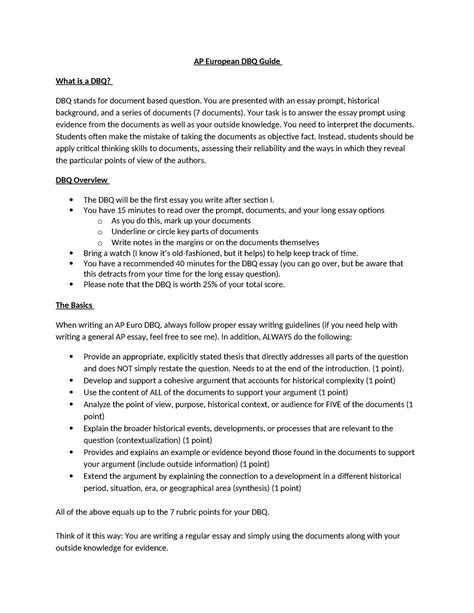
The Advanced Placement (AP) European History Document-Based Question (DBQ) is a challenging but rewarding assessment that measures students’ ability to analyze historical documents and construct a coherent argument. This guide will provide a step-by-step process to help students master the AP Euro DBQ and earn a high score.
Step 1: Understanding the DBQ Format
The AP Euro DBQ consists of seven documents related to a specific historical topic. These documents can include primary sources (e.g., letters, speeches, eyewitness accounts) and secondary sources (e.g., textbooks, historical interpretations). Students are given 70 minutes to complete the DBQ, which is divided into three parts:
- Document-Based Question: This is the prompt that provides the historical context and asks a specific question about the topic.
- Document Analysis: Students must analyze each document individually, identifying its author, purpose, main argument, and limitations.
- Thesis Statement and Argumentation: Students must craft a thesis statement that answers the DBQ prompt and use the analyzed documents as evidence to support their argument.
Step 2: Analyzing Documents
Effective document analysis is crucial for a successful DBQ. Here are the key steps:
- Identify the Source: Determine the author, date, and context of the document. Consider the author’s perspective and biases.
- Determine the Main Argument: Identify the central thesis or message of the document.
- Analyze the Evidence: Examine the specific evidence provided in the document that supports the main argument.
- Assess the Limitations: Consider any factors that may limit the credibility or validity of the document.
Step 3: Crafting a Strong Thesis Statement
The thesis statement is the foundation of the DBQ argument. It should be:
- Specific: Clearly answer the DBQ prompt and state the specific historical event or issue being addressed.
- Defensible: Supported by evidence from the analyzed documents.
- Complex: Present a nuanced argument that considers multiple perspectives and connections.
Step 4: Building an Argument Body
The body of the DBQ should:
- Organize Documents Logically: Group documents into categories or sub-theses based on their main arguments.
- Use Evidence to Support Claims: Quote or paraphrase specific passages from the documents to support each claim made in the thesis statement.
- Address Counterarguments: Acknowledge and address conflicting viewpoints or alternative interpretations of the historical event.
- Provide Context: Connect the analyzed documents to the broader historical context and provide historical background if necessary.
Step 5: Writing a Strong Conclusion
The conclusion should:
- Summarize the Argument: Briefly restate the thesis statement and highlight the main supporting arguments.
- Connect to the Prompt: Address the specific historical question posed in the DBQ prompt.
- Provide Closure: Offer a final reflection or insight that connects the DBQ topic to the broader historical understanding.
Tips for Success
- Practice with Sample DBQs: Regularly practice analyzing documents and writing DBQs on various historical topics.
- Study the Time Periods: Familiarize yourself with the major events, people, and ideas of European history from the Renaissance to the Cold War.
- Develop Analytical Skills: Hone your ability to discern the meaning and significance of historical documents.
- Read Historical Texts: Expand your knowledge of European history by reading primary and secondary sources.
- Seek Feedback from Teachers: Request guidance from teachers on your document analysis and writing skills.
Sample DBQ Prompt
Prompt: To what extent did the French Revolution advance the cause of equality in France?
Documents:
- Declaration of the Rights of Man and of the Citizen (1789)
- Letter from a peasant to the National Assembly (1790)
- Speech by Robespierre (1794)
- Article from the Code Civil (1804)
- Letter from a woman to Napoleon Bonaparte (1808)
- Speech by Louis XVIII (1814)
- Historical interpretation from a textbook
Conclusion
The AP Euro DBQ is a challenging but rewarding assessment that requires students to engage in critical thinking, document analysis, and historical interpretation. By following the steps outlined in this guide, students can develop the skills and knowledge necessary to earn a high score and demonstrate their mastery of European history.