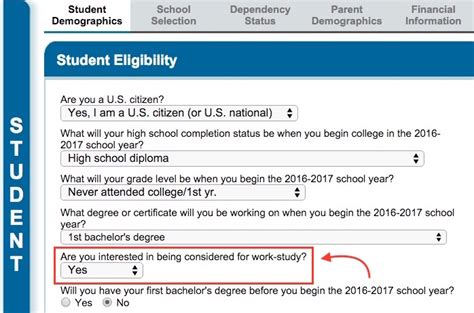
Key Eligibility Criteria and Beyond
Work-study programs provide financial aid to students by enabling them to work part-time to offset their educational expenses. Eligibility for these programs is determined by various factors, including financial need, enrollment status, and academic progress.
Basic Requirements
- Financial Need: Students must demonstrate financial need by submitting a Free Application for Federal Student Aid (FAFSA) or Renewal FAFSA. The FAFSA calculates a student’s Expected Family Contribution (EFC), which determines their eligibility for federal financial aid, including work-study.
- Enrollment Status: Work-study is primarily available to undergraduate and graduate students enrolled at least half-time (6 credit hours per semester).
- Academic Progress: Students must maintain satisfactory academic progress (SAP) to be eligible for work-study. SAP requirements vary by institution but generally involve maintaining a minimum GPA and completing a certain number of credits each semester.
Additional Considerations
- Citizenship and Residency: U.S. citizens, permanent residents, and eligible non-citizens may qualify for work-study.
- Enrollment Type: Part-time students may be eligible for work-study, but funding availability may be limited.
- Income Limits: Some work-study programs may have income limits. Students whose family income exceeds the threshold may not be eligible.
- Work Restrictions: Work-study jobs typically involve on-campus employment, although some programs may offer off-campus opportunities.
Income Limit Data
According to the Federal Student Aid website:
- For the 2023-2024 academic year, the income limit for a dependent undergraduate student is $29,000.
- For the 2023-2024 academic year, the income limit for an independent undergraduate student is $40,000.
Table 1: Income Limits for Work-Study
| Student Status | Income Limit (2023-2024) |
|---|---|
| Dependent Undergraduate | $29,000 |
| Independent Undergraduate | $40,000 |
Employment Opportunities
Work-study jobs offer a wide range of employment opportunities, including:
- Administration: Clerical, data entry, and office support
- Campus Services: Libraries, bookstores, and housing
- Education and Research: Teaching assistantships, research assistantships, and tutoring
- Maintenance and Operations: Custodial, groundskeeping, and maintenance
- Retail and Food Service: Cashiers, servers, and baristas
Table 2: Work-Study Employment Opportunities
| Category | Examples |
|---|---|
| Administration | Clerical, data entry, office support |
| Campus Services | Libraries, bookstores, housing |
| Education and Research | Teaching assistantships, research assistantships, tutoring |
| Maintenance and Operations | Custodial, groundskeeping, maintenance |
| Retail and Food Service | Cashiers, servers, baristas |
Benefits of Work-Study
Work-study programs offer several benefits to students, including:
- Income to Offset Expenses: Students can earn money to help pay for tuition, fees, and living expenses.
- Work Experience: Work-study jobs provide valuable work experience and the opportunity to develop job skills.
- Networking Opportunities: Students can connect with potential employers and expand their professional networks.
- Foundation for Careers: Work-study can provide a foundation for future employment in related fields.
Table 3: Benefits of Work-Study
| Benefit | Description |
|---|---|
| Income to Offset Expenses | Students can earn money to help pay for tuition, fees, and living expenses. |
| Work Experience | Work-study jobs provide valuable work experience and the opportunity to develop job skills. |
| Networking Opportunities | Students can connect with potential employers and expand their professional networks. |
| Foundation for Careers | Work-study can provide a foundation for future employment in related fields. |
Eligibility Process
To determine eligibility for work-study, students should complete the following steps:
- Submit a FAFSA: Complete the FAFSA to calculate their EFC and determine their financial need.
- Check with Financial Aid Office: Contact the financial aid office at their institution to inquire about work-study availability.
- Submit Application: Submit a work-study application through the financial aid office or online.
Related Keywords
- Federal Work-Study Program
- Financial Aid
- Part-Time Employment
- Student Employment
- Work and Learn Programs
Innovative Application: “Idea Generator”
The “Idea Generator” is a tool that helps students identify potential work-study positions that align with their interests and skills. The tool uses a database of work-study job descriptions and filters them based on user input.
Table 4: Comparison of Pros and Cons
| Pros | Cons |
|---|---|
| Offset educational expenses | Limited funding availability |
| Gain work experience | May impact academic workload |
| Build professional network | May require specific skills or experience |
| Explore career options | Can be competitive |