Mutations are changes to the DNA sequence of an organism. They can be caused by a variety of factors, including exposure to radiation or chemicals, errors during DNA replication, and viral infections. Mutations can have a wide range of effects, from being completely harmless to causing serious genetic disorders.

How Are Mutations Passed Along to Offspring?
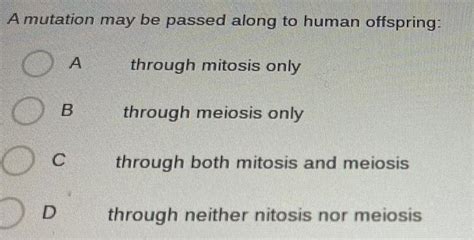
Mutations can be passed along to offspring through the germ cells (eggs and sperm). When a mutation occurs in a germ cell, it can be passed on to the next generation. If the mutation is dominant, it will be expressed in the offspring even if they only receive one copy of the mutated gene. If the mutation is recessive, it will only be expressed in the offspring if they receive two copies of the mutated gene.
What Are the Consequences of Mutations?
The consequences of mutations can vary widely depending on the type of mutation and the gene that is affected. Some mutations are harmless and have no effect on the organism. Others can cause genetic disorders, which can range in severity from mild to life-threatening.
There are a number of common mistakes that people make when thinking about mutations. These mistakes can lead to confusion and misunderstanding about the role of mutations in human health.
Here are some common mistakes to avoid:
- Thinking that all mutations are harmful. Mutations are not always harmful. In fact, many mutations are harmless and have no effect on the organism.
- Thinking that all mutations are inherited. Mutations can be either acquired or inherited. Acquired mutations occur after conception and are not passed on to offspring. Inherited mutations are present in the germ cells and can be passed on to offspring.
- Thinking that all genetic disorders are caused by mutations. Genetic disorders can be caused by a variety of factors, including mutations, chromosomal abnormalities, and environmental factors.
Here is a step-by-step approach to learning about mutations:
- Define mutations. Mutations are changes to the DNA sequence of an organism.
- Identify the different types of mutations. There are many different types of mutations, each with its own unique characteristics.
- Understand the causes of mutations. Mutations can be caused by a variety of factors, including exposure to radiation or chemicals, errors during DNA replication, and viral infections.
- Learn about the consequences of mutations. Mutations can have a wide range of consequences, from being completely harmless to causing serious genetic disorders.
- Apply your knowledge of mutations. You can use your knowledge of mutations to make informed decisions about your health and the health of your family.
Here are some frequently asked questions about mutations:
- What is the difference between a dominant and a recessive mutation? A dominant mutation is expressed even if the individual only has one copy of the mutated gene. A recessive mutation is only expressed if the individual has two copies of the mutated gene.
- Can mutations be cured? There is no cure for mutations, but some genetic disorders caused by mutations can be treated.
- Can mutations be prevented? Some mutations can be prevented by avoiding exposure to certain environmental factors, such as radiation and chemicals. However, most mutations occur randomly and cannot be prevented.
- What is the role of mutations in evolution? Mutations are the raw material for evolution. They provide the genetic variation that allows populations to adapt to changing environmental conditions.
Mutations are an important part of human health and evolution. By understanding the causes and consequences of mutations, we can make informed decisions about our health and the health of our families.
Table 1: Types of Mutations
| Type of Mutation | Description |
|---|---|
| Substitution | One nucleotide is replaced by another |
| Insertion | One or more nucleotides are added to the DNA sequence |
| Deletion | One or more nucleotides are removed from the DNA sequence |
| Inversion | A segment of DNA is reversed |
| Translocation | A segment of DNA is moved from one chromosome to another |
Table 2: Causes of Mutations
| Cause of Mutation | Description |
|---|---|
| Radiation | Exposure to high levels of radiation can damage DNA |
| Chemicals | Exposure to certain chemicals can damage DNA |
| Errors during DNA replication | Errors can occur during DNA replication, leading to mutations |
| Viral infections | Some viruses can insert their own DNA into the DNA of the host cell, leading to mutations |
Table 3: Consequences of Mutations
| Consequence of Mutation | Description |
|---|---|
| Harmless | The mutation has no effect on the organism |
| Beneficial | The mutation provides a benefit to the organism |
| Deleterious | The mutation causes a genetic disorder |
Table 4: Applications of Mutations
| Application of Mutations | Description |
|---|---|
| Gene therapy | Mutations can be used to treat genetic disorders |
| Genetic engineering | Mutations can be used to create genetically modified organisms (GMOs) |
| Forensic science | Mutations can be used to identify individuals |