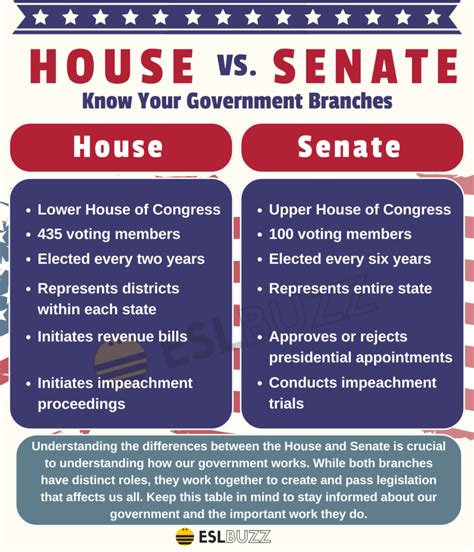
In the United States government, the House of Representatives and the Senate are the two chambers that make up the bicameral legislature. The House of Representatives is the lower chamber, while the Senate is the upper chamber. Both chambers have distinct powers and responsibilities within the legislative process.

House of Representatives
The House of Representatives is composed of 435 members, each representing a congressional district. Members of the House are elected to two-year terms. The House has the exclusive power to initiate impeachment proceedings against the president and other federal officials. It also has the sole authority to originate revenue bills.
Senate
The Senate is composed of 100 members, two from each state. Senators are elected to six-year terms. The Senate has the power to confirm presidential appointments, including cabinet members and Supreme Court justices. It also has the sole authority to try impeachment cases.
Powers and Responsibilities
The House and Senate share a number of powers and responsibilities, including:
- Passing laws: Both chambers must pass a bill before it can become law.
- Appropriating funds: Both chambers must approve the federal budget.
- Ratifying treaties: Both chambers must ratify treaties before they can become binding on the United States.
- Declaring war: Both chambers must declare war before the United States can engage in armed conflict.
Differences in Powers
In addition to their shared powers, the House and Senate also have some unique powers. The House has the exclusive power to:
- Impeach federal officials: The House can impeach the president, vice president, and other federal officials for “treason, bribery, or other high crimes and misdemeanors.”
- Originate revenue bills: The House has the sole authority to originate bills that raise revenue.
The Senate has the exclusive power to:
- Confirm presidential appointments: The Senate must confirm all presidential appointments, including cabinet members and Supreme Court justices.
- Try impeachment cases: The Senate has the sole authority to try impeachment cases.
Relationship between the House and Senate
The House and Senate often work together to pass laws and approve presidential appointments. However, there can also be conflict between the two chambers. For example, the House may impeach a president, but the Senate may not convict him or her.
Conclusion
The House of Representatives and the Senate are two essential components of the United States government. They play a vital role in the legislative process and in shaping the policies of the nation.
Table of Key Differences between the House and Senate
| Feature | House of Representatives | Senate |
|---|---|---|
| Number of members | 435 | 100 |
| Term length | 2 years | 6 years |
| Election method | Elected by district | Elected by state |
| Exclusive powers | Impeachment, revenue bills | Confirmation of appointments, treaties, impeachment trials |
Table of Shared Powers between the House and Senate
| Power |
|—|—|
| Passing laws |
| Appropriating funds |
| Ratifying treaties |
| Declaring war |
Table of Important Figures
| Figure | Number |
|---|---|
| Number of members in the House of Representatives | 435 |
| Term length for members of the House of Representatives | 2 years |
| Number of members in the Senate | 100 |
| Term length for members of the Senate | 6 years |
Table of Key Terms
| Term | Definition |
|---|---|
| Bicameral | Having two chambers |
| Impeachment | The process of accusing a federal official of a crime |
| Revenue bill | A bill that raises revenue |
| Treaty | An agreement between two or more countries |