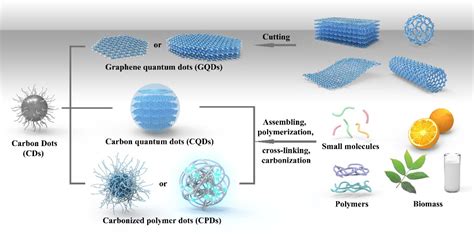
Carbon dots (CDs) have emerged as a revolutionary material, captivating the attention of researchers worldwide. This comprehensive guide delves into the fascinating world of carbon dots, providing a detailed understanding of their structure, properties, applications, and synthesis methods.

What are Carbon Dots?
Carbon dots are nano-sized carbon particles with unique properties that set them apart from other carbon nanomaterials. They typically exhibit a spherical shape and a size range of 1-10 nanometers. Their distinctive features include tunable photoluminescence, excellent biocompatibility, and exceptional stability.
Structure of Carbon Dots
The atomic structure of carbon dots is still debated, but they are generally considered to consist of a core of graphene or amorphous carbon surrounded by a functionalized surface. The core provides structural stability, while the surface groups enhance solubility, biocompatibility, and optical properties.
Properties of Carbon Dots
- Tunable Photoluminescence: CDs emit strong fluorescence with varying wavelengths depending on their size, surface chemistry, and excitation wavelength. This property makes them promising candidates for optoelectronic devices and biosensors.
- Biocompatibility: CDs have low toxicity and can interact with biological systems with minimal adverse effects. This enables their use in biomedical applications, such as drug delivery and bioimaging.
- Excellent Stability: CDs are highly resistant to degradation, making them suitable for long-term use in various environments. They are unaffected by light, heat, and solvents, ensuring their stability in harsh conditions.
Applications of Carbon Dots
The versatility of carbon dots has led to their exploration in a multitude of applications across different fields:
Biomedicine:
– Drug delivery and targeting
– Bioimaging and diagnostics
– Biosensing and disease detection
Optoelectronics:
– Light-emitting diodes (LEDs)
– Solar cells
– Optoelectronic sensors
Energy storage:
– Supercapacitors
– Batteries
Catalysis:
– Hydrogen evolution reactions
– Carbon dioxide conversion
Synthesis Methods of Carbon Dots
CDs can be synthesized through various methods, including:
Top-down approach:
– Laser ablation of carbon materials
– Chemical oxidation of carbon sources
Bottom-up approach:
– Hydrothermal synthesis
– Microwave synthesis
– Electrochemical synthesis
The choice of synthesis method depends on the desired properties and applications of the carbon dots.
Tips and Tricks for Working with Carbon Dots
- Optimization of Synthesis Parameters: Experiment with different reaction conditions, such as temperature, time, and pH, to optimize the size, morphology, and properties of carbon dots.
- Surface Functionalization: Modify the surface of carbon dots with various functional groups to enhance their solubility, biocompatibility, and targeting ability.
- Characterization Techniques: Utilize a range of characterization techniques, such as transmission electron microscopy (TEM) and X-ray diffraction (XRD), to study the structure and properties of carbon dots.
Common Mistakes to Avoid
- Overloading with Functional Groups: Avoid excessive surface functionalization, as it can compromise the optical properties and stability of carbon dots.
- Insufficient Optimization: Skipping the optimization of synthesis parameters can result in poor quality carbon dots with inconsistent properties.
- Neglecting Characterization: Failure to thoroughly characterize carbon dots can lead to incorrect conclusions about their structure and performance.
Future Prospects and Applications
The field of carbon dots is rapidly evolving, with ongoing research opening up new possibilities for their application. Here are some promising areas of exploration:
Electrocatalysis: Carbon dots show potential as catalysts for energy conversion processes, such as hydrogen production and carbon dioxide reduction.
Theranostics: Integrating carbon dots with therapeutic agents enables simultaneous diagnosis and treatment of diseases.
Artificial Intelligence (AI): Carbon dots can be employed as building blocks for AI-powered systems for data storage and computation.
Conclusion
Carbon dots represent a revolutionary material with extraordinary properties and versatile applications. Their unique structure, tunable photoluminescence, biocompatibility, and stability make them invaluable in various fields, from biomedicine to optoelectronics. As research continues to uncover the full potential of carbon dots, they are poised to transform a wide range of technologies and industries.
Table 1: Applications of Carbon Dots in Different Fields
| Field | Applications |
|---|---|
| Biomedicine | Drug delivery, bioimaging, biosensing |
| Optoelectronics | LEDs, solar cells, optoelectronic sensors |
| Energy storage | Supercapacitors, batteries |
| Catalysis | Hydrogen evolution reactions, carbon dioxide conversion |
Table 2: Synthesis Methods for Carbon Dots
| Method | Advantages | Disadvantages |
|---|---|---|
| Laser ablation | High purity | Expensive equipment |
| Chemical oxidation | Simple and scalable | Limited size control |
| Hydrothermal synthesis | Versatile and controllable | Long reaction time |
| Microwave synthesis | Rapid and efficient | Can induce defects |
| Electrochemical synthesis | Facile and low-cost | Limited scalability |
Table 3: Properties of Carbon Dots
| Property | Range |
|---|---|
| Size | 1-10 nm |
| Shape | Spherical |
| Fluorescence emission | Visible to near-infrared |
| Biocompatibility | Low toxicity |
| Stability | High resistance to degradation |
Table 4: Common Mistakes to Avoid in Working with Carbon Dots
| Mistake | Consequence |
|---|---|
| Overloading with functional groups | Compromised optical properties and stability |
| Insufficient optimization | Poor quality and inconsistent properties |
| Neglecting characterization | Incorrect conclusions about structure and performance |