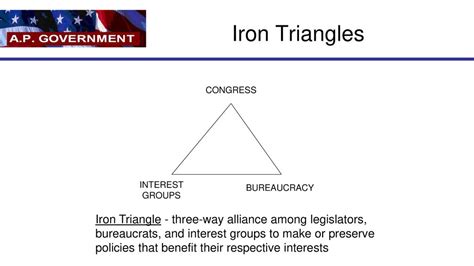
In the labyrinthine world of American politics, a formidable force known as “iron triangles” wields immense influence over policy decisions. These unholy alliances, comprising interest groups, bureaucrats, and legislators, form an unbreakable bond that ensures the protection and advancement of their shared interests.

Anatomy of an Iron Triangle
The foundation of an iron triangle lies in their common objectives. Interest groups, representing specific industries or causes, lobby for policies that benefit their members. Bureaucrats, wielding authority within government agencies, implement and enforce these policies. Legislators, motivated by campaign contributions and constituent support, approve and fund the programs that sustain the triangle’s agenda.
This symbiotic relationship creates a vicious cycle that perpetuates the dominance of iron triangles. Interest groups funnel donations to legislators, ensuring their reelection and continued support. Bureaucrats leverage their expertise and influence to shape policies in line with the interests of the triangle. Legislators, in turn, reward bureaucrats with favorable appointments and funding.
Consequences of Iron Triangles
While iron triangles can promote stability and expertise in policymaking, their unchecked influence often leads to detrimental consequences:
- Policy Capture: Iron triangles effectively hijack policy decisions by stifling alternative viewpoints and prioritizing their own narrow interests.
- Lack of Transparency: The opaque nature of these alliances makes it difficult for the public to scrutinize their activities and hold them accountable.
- Special Interest Dominance: Iron triangles privilege the concerns of well-organized and powerful groups, while marginalizing the interests of broader society.
- Erosion of Democracy: The entrenchment of iron triangles undermines the principles of responsive and representative government.
Breaking the Iron Grip
Countering the undue influence of iron triangles requires a multifaceted approach:
- Transparency and Disclosure: Mandating disclosure of campaign contributions, lobbying activities, and financial conflicts of interest sheds light on the workings of these alliances.
- Independent Oversight: Empowering independent agencies or commissions with investigative and enforcement authority can help curb potential abuses of power.
- Strengthening Citizen Engagement: Promoting civic education and fostering public participation in policymaking empowers citizens to hold decision-makers accountable.
- Reforming Electoral Financing: Reducing the role of money in politics by implementing campaign finance reforms can mitigate the influence of special interests.
Case Study: The Military-Industrial-Congressional Iron Triangle
One of the most prominent iron triangles in American politics is the Military-Industrial-Congressional (MIC) complex. This alliance, comprising defense contractors, the Department of Defense, and lawmakers on armed services committees, has a vested interest in maintaining a high level of military spending.
According to the Pentagon, the United States spent $813 billion on defense in 2023, more than the next 10 countries combined. This staggering expenditure ensures lucrative contracts for defense companies, provides jobs and economic growth in defense-dependent communities, and grants legislators political capital.
Critics argue that the MIC iron triangle has led to excessive military spending, prioritizing procurement over innovation, and perpetuating a cycle of conflict. They advocate for a more balanced approach that considers broader national priorities.
Table 1: Notable Iron Triangles in American Politics
| Interest Group | Bureaucracy | Legislature |
|---|---|---|
| National Rifle Association | Bureau of Alcohol, Tobacco, Firearms, and Explosives | House Committee on the Judiciary |
| American Medical Association | Centers for Medicare & Medicaid Services | House Committee on Energy and Commerce |
| Pharmaceutical Research and Manufacturers of America | Food and Drug Administration | Senate Committee on Health, Education, Labor, and Pensions |
Table 2: Consequences of Iron Triangles
| Negative Impact | Description |
|---|---|
| Policy Capture | Special interests dictating policy decisions without regard for public interest |
| Lack of Transparency | Secretive workings and undisclosed conflicts of interest |
| Special Interest Dominance | Interests of powerful groups prioritized over broader society |
| Erosion of Democracy | Undermining trust in government and weakening accountability |
Table 3: Strategies to Counter Iron Triangles
| Approach | Description |
|---|---|
| Transparency and Disclosure | Mandating disclosure of contributions, lobbying, and conflicts of interest |
| Independent Oversight | Empowering independent agencies to investigate and enforce ethics |
| Strengthening Citizen Engagement | Promoting civic education and public participation in policymaking |
| Reforming Electoral Financing | Reducing influence of money in politics through campaign finance reforms |
Table 4: Case Study: Military-Industrial-Congressional Iron Triangle
| Impact | Description |
|---|---|
| Excessive Military Spending | $813 billion defense budget exceeds combined spending of next 10 countries |
| Contractor Dominance | Lucrative contracts for defense companies |
| Political Capital for Legislators | Support for defense spending boosts reelection prospects |
| Perpetuation of Conflict | High military spending promotes procurement over innovation and conflicts |
Innovative Idea: Conflict Resolution Iron Triangle
Recognizing the need to address the negative consequences of iron triangles, a novel approach could foster an alliance between dispute resolution organizations, independent mediators, and policymakers. This “Conflict Resolution Iron Triangle” would prioritize diplomacy, negotiation, and consensus-building in policymaking processes. By involving experts in conflict management, policymakers could seek balanced solutions that accommodate diverse interests and mitigate the harmful effects of adversarial politics.