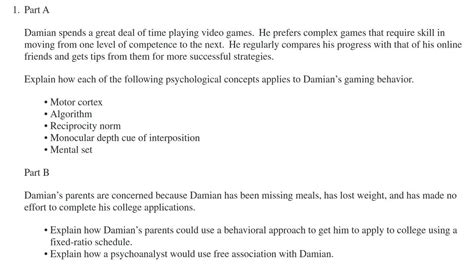
Prepare for success in the 2023 AP Psychology exam with our in-depth analysis of the upcoming free-response questions (FRQs). This guide provides essential insights, sample questions, and expert strategies to maximize your score.

Understanding the FRQ Structure
The AP Psychology FRQs consist of two long-answer prompts, each worth 20 points. These questions assess your understanding of core psychological concepts, research methods, and theories. The topics covered typically include:
- Research methods
- Biological bases of behavior
- Sensation and perception
- Learning and memory
- Motivation and emotion
- Developmental and social psychology
- Clinical and abnormal psychology
Tips and Tricks for Answering FRQs
1. Read the Question Carefully: Take your time to understand the specific requirements of each question. Highlight keywords and identify the main concepts being tested.
2. Use Psychology Jargon: Demonstrate your knowledge of psychological terminology by incorporating relevant theories, concepts, and studies in your responses.
3. Support Your Arguments with Evidence: Provide specific examples, studies, or data to support your claims. Cite reputable sources when appropriate.
4. Organize Your Response: Structure your answer in a logical and coherent manner. Use clear paragraphs to address different aspects of the question.
Common Mistakes to Avoid
1. Restating the Question: Avoid simply repeating the question in your response. Instead, focus on providing a substantive answer that demonstrates your understanding.
2. Lack of Specificity: Don’t provide vague or general responses. Use specific examples and theories to illustrate your arguments.
3. Overgeneralization: Avoid making sweeping statements that are not supported by evidence. Qualify your claims with specific conditions or limitations.
4. Off-Topic Answers: Stay focused on the question being asked. Avoid irrelevant or tangential information.
Why FRQs Matter
FRQs not only assess your knowledge of psychology but also your critical thinking, analytical writing, and synthesis skills. These skills are essential for success in college and beyond.
Benefits of FRQs
- Improved Understanding: FRQs force you to think deeply about psychological concepts and apply them to specific scenarios.
- Increased Confidence: Successfully answering FRQs builds your confidence in your knowledge and abilities.
- Better Exam Performance: FRQs account for a significant portion of the AP Psychology exam score. Mastering FRQs can boost your overall score.
Sample FRQ Questions
Question 1: Discuss the role of neurotransmitters in learning and memory. Provide specific examples of how neurotransmitters influence these processes.
Question 2: Describe the different stages of cognitive development according to Jean Piaget’s theory. Explain how social factors can influence cognitive development.
FRQ Generator: Using “Cognitionary” to Generate Creative Applications
“Cognitionary” is a new word coined to represent the intersection of cognition and technology. By combining these concepts, we can generate innovative applications that enhance our cognitive abilities:
- Enhanced Learning Tools: Personalized learning experiences that adapt to individual cognitive styles and preferences.
- Mental Health Aids: Technology-based interventions for managing stress, anxiety, and other mental health concerns.
- Cognitive Augmentation: Devices or software that improve memory, attention, and problem-solving abilities.
- Adaptive Interfaces: User interfaces that automatically adjust to different cognitive states and needs.
Data Tables for FRQ Preparation
| Topic | Example Question | Possible Keyword Answers |
|---|---|---|
| Research Methods | Describe the strengths and limitations of naturalistic observation. | Observation, bias, validity, reliability, generalizability |
| Biological Bases of Behavior | Explain the role of the hippocampus in memory formation. | Hippocampus, memory, encoding, retrieval, neuron |
| Sensation and Perception | Discuss the principles of visual perception, including color constancy and depth perception. | Color constancy, depth perception, retina, visual cortex, sensory transduction |
| Learning and Memory | Compare and contrast classical and operant conditioning. | Classical conditioning, operant conditioning, stimulus, response, reinforcement |
| Motivation and Emotion | Analyze the factors that contribute to intrinsic motivation. | Intrinsic motivation, competence, autonomy, relatedness, self-determination |
| Developmental and Social Psychology | Describe the different attachment styles and their impact on childhood development. | Attachment, secure attachment, anxious attachment, avoidant attachment, stranger anxiety |
| Clinical and Abnormal Psychology | Discuss the symptoms and treatments for major depressive disorder. | Major depressive disorder, depression, symptoms, treatments, medication, psychotherapy |
Conclusion
Mastering the AP Psychology FRQs is essential for exam success. By understanding the structure, using effective strategies, avoiding common mistakes, and utilizing our sample questions and FRQ generator, you can boost your score and demonstrate your comprehensive knowledge of psychology. Remember, your cognitive abilities are truly “cognitionary,” and with the right preparation, you can optimize your performance on the upcoming exam.