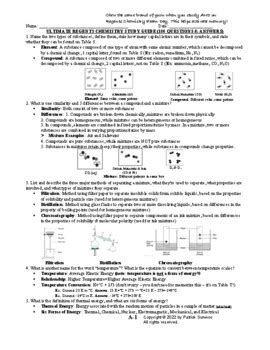
Regents Chemistry is a rigorous high school course that prepares students for college-level chemistry. The course is divided into several units, each of which covers a different aspect of chemistry.

Unit 1: Stoichiometry
Stoichiometry is the study of the quantitative relationships between reactants and products in chemical reactions. In this unit, students will learn how to:
- Balance chemical equations
- Calculate the molar mass of compounds
- Determine the limiting reactant in a reaction
- Calculate the theoretical yield of a product
Unit 2: Quantum Theory and Atomic Structure
Quantum theory is the study of the behavior of matter at the atomic and subatomic level. In this unit, students will learn about:
- The wave-particle duality of light
- The quantum mechanical model of the atom
- The electronic configuration of elements
- The periodic properties of elements
Unit 3: Molecular Geometry, Bonding, and Molecular Orbital Theory
Molecular geometry is the study of the three-dimensional arrangement of atoms in molecules. Bonding is the study of the forces that hold atoms together in molecules. Molecular orbital theory is a quantum mechanical model of the electronic structure of molecules. In this unit, students will learn about:
- The shapes of molecules
- The types of chemical bonds
- The molecular orbital diagrams of molecules
- The hybridization of atomic orbitals
Unit 4: States of Matter
The states of matter are the different phases of matter, such as solids, liquids, and gases. In this unit, students will learn about:
- The physical properties of solids, liquids, and gases
- The phase changes between solids, liquids, and gases
- The kinetic molecular theory of matter
Unit 5: Solutions
Solutions are mixtures of two or more substances that are evenly distributed throughout the mixture. In this unit, students will learn about:
- The concentration of solutions
- The colligative properties of solutions
- The types of chemical reactions that occur in solutions
Unit 6: Equilibrium
Equilibrium is a state of balance in which the forward and reverse reactions of a chemical reaction occur at the same rate. In this unit, students will learn about:
- The equilibrium constant
- The factors that affect equilibrium
- The applications of equilibrium
Unit 7: Acids, Bases, and Salts
Acids, bases, and salts are important substances that play a role in many chemical reactions. In this unit, students will learn about:
- The properties of acids, bases, and salts
- The pH of solutions
- The neutralization of acids and bases
Unit 8: Electrochemistry
Electrochemistry is the study of the relationship between electricity and chemical reactions. In this unit, students will learn about:
- The electrochemical cell
- The standard hydrogen electrode
- The Nernst equation
- The electrolysis of solutions
Unit 9: Nuclear Chemistry
Nuclear chemistry is the study of the nucleus of the atom and the changes that occur in the nucleus. In this unit, students will learn about:
- The structure of the nucleus
- The types of nuclear reactions
- The applications of nuclear chemistry
Why Regents Chemistry Units Matter
Regents Chemistry is a challenging course, but it is also a very rewarding one. Students who complete this course will have a strong foundation in chemistry and will be well-prepared for college-level chemistry and other science courses.
In addition, Regents Chemistry is a valuable course for students who are planning to pursue careers in science, engineering, or medicine. These careers require a strong understanding of chemistry, and Regents Chemistry will provide students with the necessary knowledge and skills to succeed in these fields.
Benefits of Regents Chemistry
There are many benefits to taking Regents Chemistry. Some of the benefits include:
- Improved critical thinking skills. Chemistry is a challenging subject that requires students to use their critical thinking skills to solve problems. Regents Chemistry will help students develop the critical thinking skills that they need to succeed in college and in their careers.
- Enhanced problem-solving skills. Chemistry is a problem-solving subject. Regents Chemistry will help students develop the problem-solving skills that they need to succeed in college and in their careers.
- Greater understanding of the world around them. Chemistry is the study of the world around us. Regents Chemistry will help students understand the world around them and how it works.
- Preparation for college and careers. Regents Chemistry is a valuable course for students who are planning to pursue careers in science, engineering, or medicine. This course will provide students with the necessary knowledge and skills to succeed in these fields.
Effective Strategies for Regents Chemistry
There are many effective strategies that you can use to succeed in Regents Chemistry. Some of these strategies include:
- Attend class regularly. Class is one of the best ways to learn about chemistry. When you attend class, you will hear the material from your teacher, see it written on the board, and discuss it with your classmates. This will help you to understand the material and to remember it.
- Take notes. Taking notes during class will help you to remember the material and to clarify your understanding of the material. When you take notes, be sure to write down the main points of the lecture and any examples that your teacher gives.
- Do your homework. Homework is an important part of the learning process. When you do your homework, you will practice the skills that you learned in class and you will identify areas where you need further study.
- Study for tests. Studying for tests is essential for success in Regents Chemistry. When you study for tests, be sure to review your notes, do practice problems, and take practice tests.
- Get help when you need it. If you are struggling with a particular topic in chemistry, do not be afraid to ask your teacher or a classmate for help. There are also many online resources that can help you to learn about chemistry.
FAQs About Regents Chemistry Units
1. What is Regents Chemistry?
Regents Chemistry is a high school chemistry course that is aligned with the New York State Regents Exam. This course covers a wide range of chemistry topics, including stoichiometry, quantum theory, atomic structure, molecular geometry, bonding, molecular orbital theory, states of matter, solutions, equilibrium, acids, bases, and salts, electrochemistry, and nuclear chemistry.
2. What are the benefits of taking Regents Chemistry?
There are many benefits to taking Regents Chemistry. Some of these benefits include:
- Improved critical thinking skills
- Enhanced problem-solving skills
- Greater understanding of the world around you
- Preparation for college and careers
3. What are some effective strategies for Regents Chemistry?
There are many effective strategies that you can use to succeed in Regents Chemistry. Some of these strategies include:
- Attend class regularly
- Take notes
- Do your homework
- Study for tests
- Get help when you need it
4. What is the Regents Exam?
The Regents Exam is a standardized test that is administered to all high school students in New York State. The Regents Exam is used to assess student learning and to determine whether students have met the state standards for graduation.
5. How can I prepare for the Regents Exam?
There are many ways to prepare for the Regents Exam. Some of these ways include:
- Taking a Regents Chemistry course
- Studying for the exam
- Taking practice tests
- Getting help from your teacher or a tutor
6. What is the passing score for the Regents Exam?
The passing score for the Regents Exam is 65%.
7. What happens if I fail the Regents Exam?
If you fail the Regents Exam, you can retake the exam in August. You can also take a Regents Chemistry course at a local community college or university.
8. What are some careers that require Regents Chemistry?
There are many careers that require Regents Chemistry. Some of these careers include:
- Chemistry teacher
- Chemical engineer
- Doctor
- Pharmacist
- Research scientist