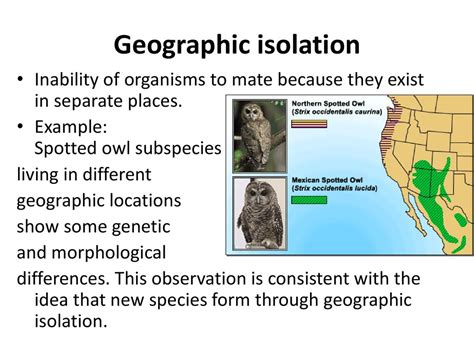
Definition of Geographical Isolation
Geographical isolation is a phenomenon that occurs when a population of organisms is separated from other conspecific populations by geographical barriers, such as mountains, rivers, or oceans. This separation prevents gene flow between isolated populations, leading to the accumulation of genetic differences over time.

Causes of Geographical Isolation
- Physical Barriers: Mountains, rivers, oceans, and deserts can act as barriers, preventing the movement of organisms between populations.
- Dispersal Limitations: Some species may have limited dispersal capabilities, making it difficult for them to cross geographical barriers.
- Habitat Fragmentation: Human activities, such as urbanization and deforestation, can fragment habitats, isolating populations.
Consequences of Geographical Isolation
1. Genetic Divergence
Geographical isolation can lead to genetic divergence, as isolated populations evolve independently. This divergence can occur through processes such as:
- Genetic Drift: Random changes in allele frequencies within small isolated populations.
- Founder Effect: Loss of genetic variation due to a small number of individuals founding a new population.
- Bottleneck Effect: A reduction in population size due to a catastrophic event, leading to the loss of genetic diversity.
2. Speciation
Over time, genetic divergence can accumulate to the point where isolated populations become reproductively isolated. This can lead to the emergence of new species, a process known as allopatric speciation.
3. Adaptation
Geographical isolation can facilitate adaptation to local environmental conditions. Isolated populations may experience different environmental pressures than their ancestral population, leading to the evolution of distinct traits that enhance their survival in the new environment.
4. Extinction Risk
Isolated populations may be more susceptible to extinction due to their reduced genetic diversity and small population size. They are more vulnerable to environmental changes, inbreeding, and genetic disorders.
Applications of Geographical Isolation
1. Conservation Biology
Understanding geographical isolation helps conservationists identify and protect endangered species. Isolating populations can prevent hybridization, maintain genetic diversity, and bolster species resilience.
2. Evolutionary Studies
Geographical isolation provides a natural laboratory for studying evolutionary processes. By comparing isolated populations, researchers can gain insights into the role of genetic drift, founder effects, and adaptation in shaping genetic variation.
3. Agriculture
Geographical isolation can be used to create new crop varieties with desirable traits. By isolating populations and selecting for specific traits, breeders can develop plants that are resistant to pests, diseases, or environmental stresses.
4. Disease Control
Geographical isolation can prevent the spread of infectious diseases. By quarantining infected individuals or populations, public health officials can limit the transmission of pathogens.
Effective Strategies for Managing Geographical Isolation
- Population Monitoring: Track the size and genetic diversity of isolated populations to assess their vulnerability to extinction.
- Assisted Gene Flow: Introduce individuals from other populations to increase genetic diversity and reduce the risk of inbreeding.
- Habitat Connectivity: Create or restore corridors that allow movement between isolated populations, facilitating gene flow.
- Adaptive Management: Implement strategies that are flexible and adaptable to changing environmental conditions and population dynamics.
Tips and Tricks for Studying Geographical Isolation
- Use Molecular Markers: Analyze genetic data to assess genetic divergence and identify distinct populations.
- Conduct Comparative Studies: Compare isolated populations to closely related populations to identify traits that have evolved through isolation.
- Model Population Dynamics: Use mathematical models to predict the effects of isolation on population size and genetic diversity.
- Consider Historical Factors: Examine historical records and geological evidence to understand the timing and causes of geographical isolation.
Step-by-Step Approach to Studying Geographical Isolation
- Identify isolated populations using physical barriers or population genetic data.
- Assess genetic divergence using molecular markers (e.g., DNA sequencing).
- Determine the causes of isolation (e.g., physical barriers, dispersal limitations).
- Analyze the ecological and evolutionary consequences of isolation (e.g., adaptation, speciation risk).
- Implement appropriate management strategies to conserve isolated populations or prevent disease spread.