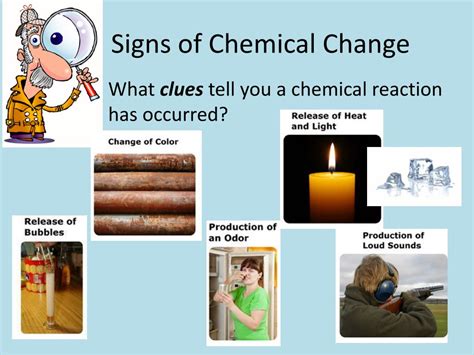
Chemical changes, unlike physical changes, involve the transformation of one or more substances into entirely new substances with distinct properties. These transformations are often accompanied by observable signs that indicate a chemical reaction has taken place. Understanding these indicators is crucial for recognizing and interpreting chemical reactions.

Visible Signs of Chemical Change
1. Change in Color:
One of the most noticeable signs of a chemical change is a change in color. This occurs when the reactants absorb or emit light at different wavelengths than the products. For instance, iron rusting undergoes a color change from a metallic gray to a reddish-brown hue, indicating the formation of iron oxide.
2. Production of Gas:
The release of gas bubbles is a telltale sign of a chemical reaction. This gas can be detected by its appearance, odor, or sound. For example, the reaction between baking soda and vinegar produces carbon dioxide gas, which creates bubbles and causes the mixture to fizz.
3. Formation of a Precipitate:
When two soluble reactants react to form an insoluble solid, a precipitate forms. This solid settles at the bottom of the reaction vessel, indicating a chemical change. An example is the reaction between silver nitrate and sodium chloride, which produces a white precipitate of silver chloride.
4. Change in Temperature:
Chemical reactions can release or absorb energy, leading to a change in temperature. Exothermic reactions release heat, causing the temperature to rise. Conversely, endothermic reactions absorb heat, resulting in a decrease in temperature. The combustion of fuels is an example of an exothermic reaction.
Other Indications of Chemical Change
1. Change in Odor:
A chemical change can produce substances with distinct odors. For instance, the reaction between hydrogen sulfide and oxygen results in the formation of sulfur dioxide, which has a pungent odor.
2. Change in Density:
The density of the reactants and products of a chemical reaction may differ. This change can be observed by comparing the relative weights of equal volumes of the two substances.
3. Change in Conductivity:
Solutions of ionic compounds can conduct electricity. When a chemical reaction occurs, the conductivity of the solution may change due to the formation or consumption of ions.
4. Formation of Radiation:
Some chemical changes involve the emission of radiation, such as gamma rays or X-rays. This radiation can be detected using specialized instruments. Radioisotope decay is an example of a chemical reaction that produces radiation.
Table 1: Examples of Chemical Changes
| Reactants | Products | Observations |
|---|---|---|
| Iron and oxygen | Iron oxide | Color change from gray to reddish-brown |
| Sodium chloride and silver nitrate | Silver chloride | Formation of a white precipitate |
| Hydrogen sulfide and oxygen | Sulfur dioxide | Production of a pungent odor |
| Baking soda and vinegar | Carbon dioxide gas | Bubbles and fizzing |
Table 2: Applications of Chemical Changes
| Application | Chemical Reaction |
|---|---|
| Food preservation | Canning, drying, freezing |
| Medicine | Drug synthesis, disease diagnosis |
| Energy production | Combustion, nuclear reactions |
| Industrial processes | Metallurgy, chemical manufacturing |
Table 3: FAQs about Chemical Changes
| Question | Answer |
|---|---|
| What causes chemical changes? | Rearrangement of atoms and molecules |
| Are all physical changes also chemical changes? | No, only changes involving the formation of new substances are chemical changes |
| Can chemical changes be reversed? | Some can, but many are irreversible |
| What are the benefits of understanding chemical changes? | Helps predict reactions, develop new technologies, and improve everyday life |
Table 4: Innovative Applications of Chemical Changes
| Concept | Description | Potential Applications |
|---|---|---|
| Thermosynthesis | Chemical reactions triggered by temperature changes | Novel materials, self-healing polymers |
| Electrosynthesis | Chemical reactions initiated by electricity | Green chemistry, renewable energy storage |
| Biocatalysis | Use of enzymes or whole cells in chemical reactions | Drug development, bioremediation |
| Molecular self-assembly | Spontaneous organization of molecules into complex structures | Nanotechnology, electronic devices |
Conclusion
Understanding the signs of chemical changes is essential for interpreting chemical reactions and predicting their outcomes. These indicators range from visible changes (e.g., color, gas production) to less obvious changes (e.g., temperature, conductivity). By recognizing these signs, scientists, researchers, and everyday individuals can gain valuable insights into the world of chemical transformations.