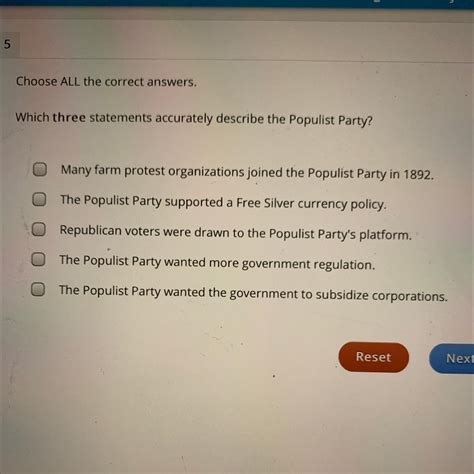
Populism can be challenging to define, but some key features may help identify a populist party. In this article, we discuss the three statements which accurately describe the populist party.

1. They claim to represent the “common people” against the “elite.”
Populist parties often present themselves as champions of the ordinary people against a perceived elite. This elite can include powerful politicians, wealthy individuals, or multinational corporations. Populist parties argue that the elite are out of touch with the concerns of ordinary people and only serve their own interests.
2. They use simple and emotional language to appeal to voters’ fears and resentments.
Populist parties often use simple and emotional language to appeal to voters’ fears and resentments. They may use terms like “crooked politicians” or “greedy corporations” to describe their opponents. They may also use scapegoats to blame for the problems facing the country, such as immigrants or minorities.
3. They offer simple solutions to complex problems.
Populist parties often offer simple solutions to complex problems. For example, they may promise to lower taxes, increase tariffs, or withdraw from international agreements. These solutions are often unrealistic or impractical, but they may appeal to voters who are looking for a quick and easy fix to their problems.
Conclusion
Populist parties can be found in many countries around the world. They often appeal to voters who are angry and frustrated with the status quo. However, populist parties can also be dangerous. They can divide society, erode trust in institutions, and lead to authoritarianism.
FAQs
1. What is the difference between populism and democracy?
Populism is a political ideology that emphasizes the importance of the common people and their concerns. Democracy is a system of government in which all or most citizens have the right to participate in the decision-making process. Populist parties can be democratic, but they can also be authoritarian.
2. What are some examples of populist parties?
Some examples of populist parties include the Five Star Movement in Italy, the National Front in France, the AfD in Germany, and the Tea Party movement in the United States.
3. What are the dangers of populism?
Populism can be dangerous because it can divide society, erode trust in institutions, and lead to authoritarianism. Populist leaders often use scapegoats to blame for the problems facing the country, and they may use simple and emotional language to appeal to voters’ fears and resentments.
4. How can we protect ourselves from the dangers of populism?
We can protect ourselves from the dangers of populism by being informed about the issues, being critical of the claims made by populist leaders, and supporting democratic institutions. We can also work to build bridges between different groups of people and to promote understanding and tolerance.
5. What is the future of populism?
The future of populism is uncertain. However, it is likely that populist parties will continue to be a force in politics for some time to come. It is important to be aware of the dangers of populism and to work to protect our democratic institutions.
6. What are some examples of populist policies?
Some examples of populist policies include:
- Raising tariffs to protect domestic industries
- Withdrawing from international agreements
- Reducing taxes for the wealthy
- Increasing welfare benefits for the poor
- Investing in infrastructure projects
- Nationalizing industries
7. What are the benefits of populism?
Populist policies can sometimes be beneficial to certain groups of people. For example, raising tariffs can protect domestic industries and jobs. Withdrawing from international agreements can give a country more control over its own affairs. Reducing taxes for the wealthy can stimulate economic growth. Increasing welfare benefits for the poor can reduce poverty. Investing in infrastructure projects can create jobs and improve the economy. Nationalizing industries can give the government more control over the economy.
8. What are the risks of populism?
Populist policies can also be risky. For example, raising tariffs can lead to trade wars and economic damage. Withdrawing from international agreements can isolate a country from the rest of the world. Reducing taxes for the wealthy can increase inequality. Increasing welfare benefits for the poor can lead to dependency and reduce incentives to work. Investing in infrastructure projects can be expensive and inefficient. Nationalizing industries can reduce economic efficiency and innovation.