Introduction

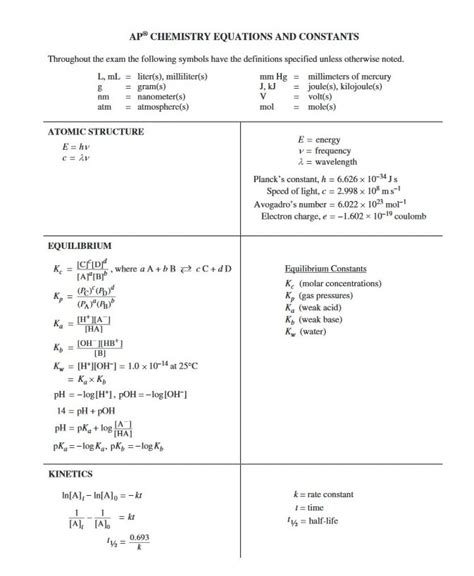
The Advanced Placement (AP) Chemistry course is a challenging but rewarding experience that can prepare students for success in college-level chemistry courses. One of the most important tools for success in AP Chemistry is a comprehensive equation sheet that outlines the key equations and concepts covered in the course.
This article provides a comprehensive guide to the AP Chem equation sheet, including:
- What is included on the AP Chem equation sheet?
- How to use the AP Chem equation sheet effectively
- Tips for memorizing the AP Chem equations
- Practice problems and solutions
What is included on the AP Chem equation sheet?
The AP Chem equation sheet is a one-page document that contains the following information:
- Thermochemistry equations: These equations are used to calculate the enthalpy change of a chemical reaction.
- Kinetics equations: These equations are used to determine the rate of a chemical reaction.
- Equilibrium equations: These equations are used to predict the equilibrium concentrations of reactants and products in a chemical reaction.
- Electrochemistry equations: These equations are used to calculate the potential of a voltaic cell and the products of electrolysis.
- Gas laws: These equations are used to predict the behavior of gases under different conditions.
- Solution chemistry equations: These equations are used to calculate the concentration of a solution and the pH of a solution.
- Nuclear chemistry equations: These equations are used to predict the products of a nuclear reaction.
How to use the AP Chem equation sheet effectively
The AP Chem equation sheet is a valuable tool for success in the course, but it is important to use it effectively. Here are some tips for using the equation sheet:
- Become familiar with the layout of the equation sheet. This will help you to quickly find the equations you need.
- Understand the meaning of each equation. Don’t just memorize the equations; make sure you understand what they mean and how to use them.
- Use the equation sheet as a reference. Don’t rely on the equation sheet to do your work for you. Use it as a reference to help you solve problems and understand concepts.
- Practice using the equation sheet. The best way to learn how to use the equation sheet is to practice using it. Solve practice problems and check your answers to make sure you are using the equations correctly.
Tips for memorizing the AP Chem equations
Memorizing the AP Chem equations can be a challenge, but there are some strategies that can help. Here are some tips for memorizing the equations:
- Break down the equations into smaller chunks. This will make them easier to remember.
- Use flashcards. Flashcards are a great way to test your memory of the equations.
- Create mnemonic devices. Mnemonic devices are memory aids that can help you to remember the equations.
- Practice using the equations. The best way to memorize the equations is to practice using them.
Practice problems and solutions
Here are some practice problems that you can use to test your understanding of the AP Chem equation sheet:
Problem 1:
Calculate the enthalpy change of the following reaction:
CH4(g) + 2O2(g) → CO2(g) + 2H2O(g)
Solution:
The enthalpy change of a reaction is equal to the difference between the enthalpy of the products and the enthalpy of the reactants. The enthalpy of formation of CH4(g) is -74.8 kJ/mol, the enthalpy of formation of O2(g) is 0 kJ/mol, the enthalpy of formation of CO2(g) is -393.5 kJ/mol, and the enthalpy of formation of H2O(g) is -241.8 kJ/mol. Therefore, the enthalpy change of the reaction is:
ΔH = ΣHf(products) – ΣHf(reactants)
ΔH = [-393.5 kJ/mol + (-241.8 kJ/mol)] – [-74.8 kJ/mol + (0 kJ/mol)]
ΔH = -802.1 kJ/mol
Problem 2:
Calculate the rate of the following reaction:
2NO(g) + 2H2(g) → N2(g) + 2H2O(g)
The rate law for the reaction is:
rate = k[NO]^2[H2]
The concentration of NO is 0.10 M, the concentration of H2 is 0.20 M, and the rate constant is 2.0 x 10^-3 M^-2 s^-1.
Solution:
The rate of the reaction is:
rate = k[NO]^2[H2]
rate = (2.0 x 10^-3 M^-2 s^-1)(0.10 M)^2(0.20 M)
rate = 8.0 x 10^-6 M/s
FAQs
1. What is the purpose of the AP Chem equation sheet?
The AP Chem equation sheet is a one-page document that contains the key equations and concepts covered in the AP Chemistry course. It is a valuable tool for success in the course, as it can help students to solve problems, understand concepts, and memorize the equations.
2. How do I use the AP Chem equation sheet effectively?
To use the AP Chem equation sheet effectively, you should:
- Become familiar with the layout of the equation sheet.
- Understand the meaning of each equation.
- Use the equation sheet as a reference.
- Practice using the equation sheet.
3. How can I memorize the AP Chem equations?
There are several strategies that you can use to memorize the AP Chem equations, such as:
- Break down the equations into smaller chunks.
- Use flashcards.
- Create mnemonic devices.
- Practice using the equations.
4. What are some practice problems that I can use to test my understanding of the AP Chem equation sheet?
Here are some practice problems that you can use to test your understanding of the AP Chem equation sheet:
- Calculate the enthalpy change of the following reaction:
CH4(g) + 2O2(g) → CO2(g) + 2H2O(g)
- Calculate the rate of the following reaction:
2NO(g) + 2H2(g) → N2(g) + 2H2O(g)
The rate law for the reaction is:
rate = k[NO]^2[H2]
The concentration of NO is 0.10 M, the concentration of H2 is 0.20 M, and the rate constant is 2.0 x 10^-3 M^-2 s^-1.
5. What are some tips for success in AP Chemistry?
Here are some tips for success in AP Chemistry:
- Attend class regularly and take good notes.
- Read the textbook and do the homework assignments.
- Study for tests and quizzes.
- Join a study group.
- Get help from your teacher or a tutor if you need it.
Conclusion
The AP Chem equation sheet is a valuable tool for success in the AP Chemistry course. By using the equation sheet effectively, you can improve your understanding of the course material and your ability to solve problems. Follow the tips and strategies outlined in this article to learn the equations, understand the concepts, and succeed in AP Chemistry.