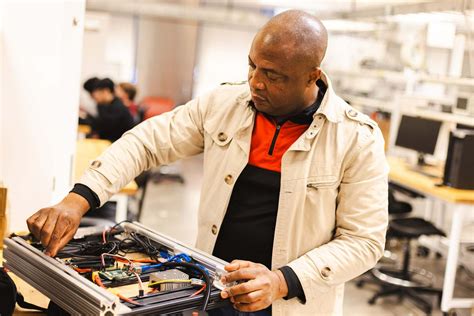
Why Choose UT Dallas for Electrical Engineering?
The Electrical Engineering program at The University of Texas at Dallas (UTD) is renowned for its excellence in research, education, and industry partnerships. With state-of-the-art facilities, an exceptional faculty, and a vibrant research community, UTD provides students with an unparalleled learning experience.

World-Class Faculty and Research
UTD’s electrical engineering faculty is composed of distinguished scholars and researchers who are actively engaged in cutting-edge research. The department boasts over 50 renowned faculty members, including 25 IEEE Fellows, 6 NSF CAREER Award recipients, and 13 distinguished professors.
The department’s research excellence is reflected in its significant funding from federal agencies such as the National Science Foundation (NSF), Department of Energy (DOE), and National Institutes of Health (NIH). In 2022, the department received over $22 million in research funding.
Cutting-Edge Research Facilities
UTD provides students with access to state-of-the-art research facilities, including:
- The Erik Jonsson School of Engineering and Computer Science (ECS) Building, a $125 million complex housing advanced laboratories and research centers.
- The Advanced Nanoelectronics Research Center (ANRC), a world-renowned facility for research in nanoelectronics and advanced materials.
- The Texas Analog Center of Excellence (TACE), a leading center for analog circuit design and research.
Industry Connections and Partnerships
UTD has strong ties with industry leaders, such as Texas Instruments, Raytheon, and Cisco Systems. These partnerships provide students with opportunities for internships, research collaborations, and career development.
Program Highlights
Undergraduate Program
- Bachelor of Science (B.S.) in Electrical Engineering
- Focus on core electrical engineering concepts and design principles
- Hands-on laboratory experiences and project-based learning
- Preparation for careers in industry or graduate studies
Graduate Program
- Master of Science (M.S.) in Electrical Engineering
- Concentrations in Communications, Controls, Power Systems, and VLSI Design
- Thesis and non-thesis options available
- Preparation for advanced roles in industry or academia
Research Areas
UTD’s electrical engineering research encompasses a wide range of areas, including:
- Analog and mixed-signal design
- Biomedical engineering
- Communications and networking
- Control systems
- Power systems
- VLSI design and nanotechnology
Why is Electrical Engineering at UT Dallas Right for You?
If you are passionate about solving complex engineering problems, working with cutting-edge technologies, and making a positive impact on the world, then UTD’s Electrical Engineering program is the perfect choice for you.
Potential Career Opportunities
Graduates with a degree in electrical engineering from UTD are in high demand by top employers in a variety of industries, including:
- Electronics manufacturing
- Semiconductor industry
- Aerospace and defense
- Biomedical engineering
- Telecommunications
Inspiring Success Stories
Alumni of UTD’s Electrical Engineering program have gone on to achieve remarkable success in their careers. Some notable examples include:
- Gwen Kramer (’99 M.S.), Senior Vice President and General Manager, Intel Corporation
- David Shen (’02 B.S.), Co-Founder and CEO, Valence Technology
- John Chu (’07 B.S.), Principal Engineer, Apple Inc.
FAQs
What is the acceptance rate for the Electrical Engineering program at UT Dallas?
The acceptance rate for the Electrical Engineering program varies from year to year, but typically ranges between 50% and 60%.
What is the average starting salary for electrical engineers?
According to the U.S. Bureau of Labor Statistics, the median annual salary for electrical engineers in the United States is $100,990.
What are the job prospects for electrical engineers?
Job prospects for electrical engineers are expected to remain strong in the coming years. The U.S. Bureau of Labor Statistics projects a 4% growth in employment for electrical engineers from 2021 to 2031.
Conclusion
If you are seeking an exceptional electrical engineering education that will prepare you for success in a rapidly changing world, look no further than UT Dallas. With its world-class faculty, cutting-edge research facilities, and strong industry connections, UTD is the ideal place to ignite your innovation and shape the future of electrical engineering.
Tips for Success
- Engage with faculty: Attend office hours, participate in research projects, and seek guidance from your professors.
- Join clubs and organizations: Get involved in the Institute of Electrical and Electronics Engineers (IEEE), the American Institute of Aeronautics and Astronautics (AIAA), and other engineering clubs.
- Build a solid foundation: Focus on understanding the fundamentals of electrical engineering, such as circuit analysis, electromagnetism, and digital logic.
- Practice problem-solving: Work on assignments, practice problems, and participate in design competitions to develop your problem-solving skills.
- Stay up-to-date with technology: Keep abreast of the latest advancements in electrical engineering by reading technical papers, attending conferences, and networking with professionals in the field.
Effective Strategies
- Create a study schedule and stick to it: Consistency is key to success in electrical engineering. Plan your study time wisely and make sure to review material regularly.
- Utilize online resources: Take advantage of online lectures, videos, and simulations to supplement your classroom learning.
- Form study groups: Collaborating with classmates can help you understand concepts better and work through problems more effectively.
- Seek help when needed: Don’t hesitate to reach out to your professors, teaching assistants, or classmates for assistance when you encounter difficulties.
- Get involved in research: Conduct research projects or participate in internships to gain practical experience and enhance your job prospects.
Tables
Table 1: UT Dallas Electrical Engineering Program Statistics
| Statistic | Value |
|---|---|
| Number of faculty | Over 50 |
| Number of students | Over 1,000 |
| Research funding in 2022 | Over $22 million |
| Acceptance rate | 50%-60% |
Table 2: Job Prospects for Electrical Engineers
| Source | Projected Growth (2021-2031) |
|---|---|
| U.S. Bureau of Labor Statistics | 4% |
| Bureau of Labor Statistics, Texas | 6.7% |
Table 3: Potential Career Paths for Electrical Engineers
| Career Path | Industries |
|---|---|
| Electronics manufacturing | Computer hardware, telecommunications, consumer electronics |
| Semiconductor industry | Chip design, fabrication, testing |
| Aerospace and defense | Avionics, radar systems, satellite communications |
| Biomedical engineering | Medical devices, healthcare technologies, biotechnology |
| Telecommunications | Networking, wireless communications, optical fiber systems |
Table 4: Effective Strategies for Success in Electrical Engineering
| Strategy | Description |
|---|---|
| Create a study schedule | Plan and allocate specific time each day or week for studying. |
| Utilize online resources | Supplement classroom learning with online lectures, videos, and simulations. |
| Form study groups | Collaborate with classmates to discuss course material and work through problems. |
| Seek help when needed | Reach out to professors, teaching assistants, or classmates for assistance when encountering difficulties. |
| Get involved in research | Conduct research projects or participate in internships to gain practical experience and enhance job prospects. |